A shipment leaving India for Europe or the Middle East usually follows a carefully planned route. The exporter books space with a shipping line, prepares the cargo, completes export documentation and waits for the vessel to carry the goods towards their destination.
But international shipping does not always follow the route printed on the original booking confirmation.
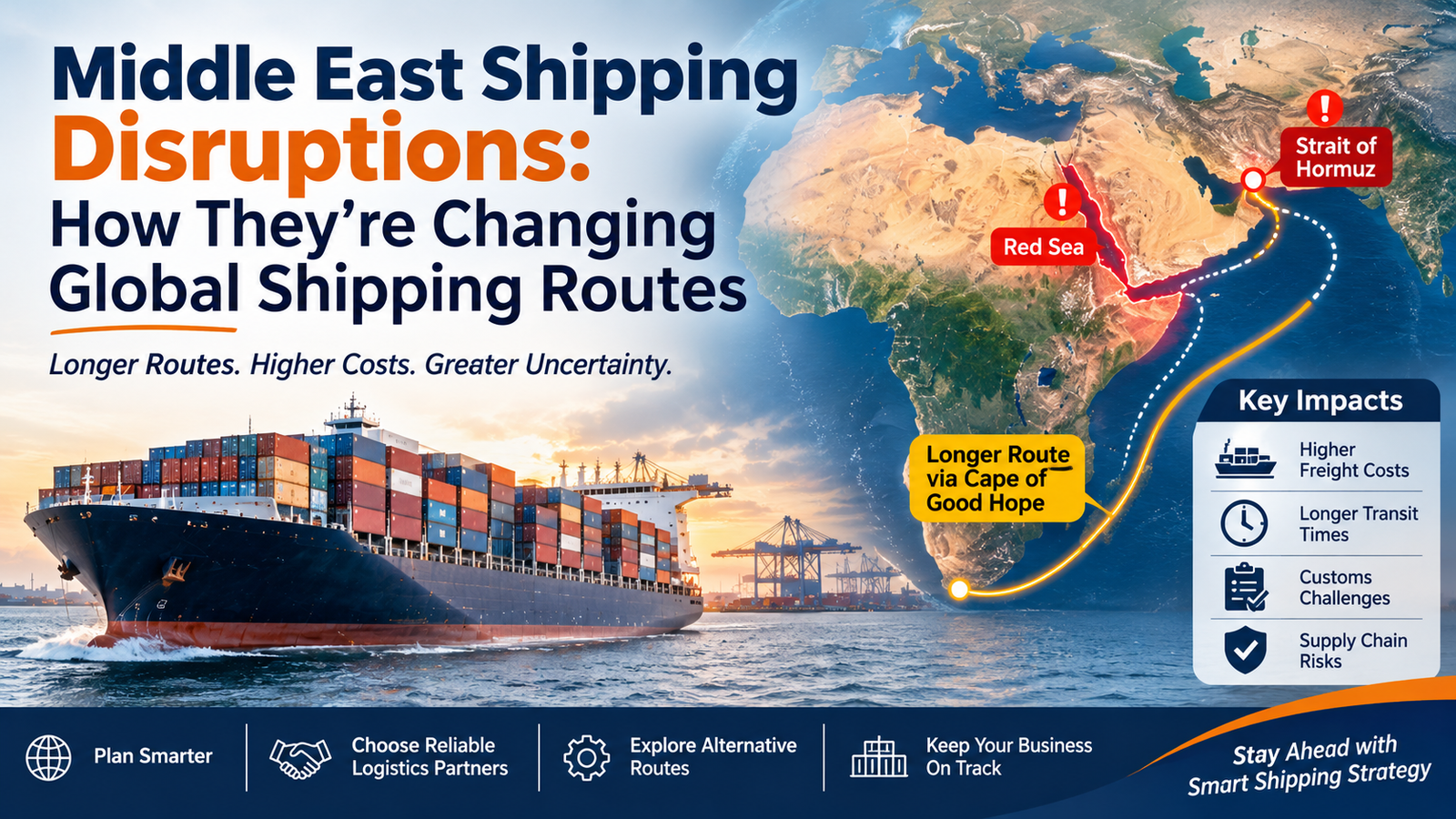
When security risks increase around important waterways, shipping companies may change vessel schedules, avoid certain ports or send ships along longer routes. A journey that once passed through the Red Sea and Suez Canal may instead travel around the southern tip of Africa. Cargo intended for Gulf destinations may need alternative transshipment arrangements, additional handling or a different delivery plan.
These changes are not just a concern for shipping companies. They affect Indian exporters, international manufacturers, importers, retailers and businesses that depend on predictable deliveries.
In 2026, disruptions around the Middle East have brought two important maritime passages into sharper focus: the Strait of Hormuz and the Red Sea–Bab el-Mandeb–Suez Canal corridor. Both are strategically important, but the operational challenges affecting them are not identical.
For businesses involved in international shipping, understanding these developments is essential. Longer transit times, higher freight costs, war-risk insurance, port congestion and customs clearance requirements can all influence the final cost and delivery of a shipment.
This article explains how Middle East disruptions are changing global shipping routes, what the developments mean for Indian trade and how businesses can prepare for a more uncertain shipping environment.
Why Is the Middle East So Important for Global Shipping?
The Middle East sits between major trading regions in Asia, Europe and Africa. Its ports and waterways connect manufacturers, energy suppliers, distributors and consumers across several continents.
Two routes are particularly important.
1. The Red Sea and Suez Canal Route
The Red Sea connects to the Mediterranean through the Suez Canal and to the Gulf of Aden through the Bab el-Mandeb Strait.
For ships travelling between Asia and Europe, this route can provide a considerably shorter journey than sailing around the Cape of Good Hope in southern Africa.
The Suez Canal is especially important for container shipping, manufactured goods, consumer products, machinery and energy transportation. When vessels avoid the Red Sea, they may need to travel around Africa, adding distance, fuel consumption and time to the voyage.
2. The Strait of Hormuz
The Strait of Hormuz connects the Persian Gulf with the Gulf of Oman and the Arabian Sea. It is one of the world’s most important passages for energy transportation.
It is relevant to oil and gas shipments, tankers, bulk cargo and commercial shipping serving Gulf markets.
Disruption in this area can affect more than the vessels directly passing through the strait. It can also influence marine insurance, vessel availability, port operations, fuel prices and shipping arrangements for businesses trading with Gulf countries.
The distinction is important: disruption around Hormuz can affect Gulf cargo and energy movements, while problems around the Red Sea and Suez can affect a much wider range of Asia–Europe shipping services.
What Is Happening to Middle East Shipping Routes in 2026?
The shipping situation has changed several times during 2026.
Following the escalation of conflict in the region on 28 February 2026, maritime and air cargo operations faced significant disruption. Shipping companies reviewed their routes, and businesses began dealing with longer transit times, higher freight charges and uncertainty around vessel schedules.
The Directorate General of Shipping in India acknowledged these problems in its March 2026 public notice. Exporters reported concerns involving vessel routing, increased transit times, higher freight rates and other operational challenges affecting sea shipments from India.
The situation has continued to evolve. By October 2026, Red Sea container traffic was showing signs of recovery, with more shipping services returning to the Suez route. However, the recovery remained incomplete.
Lloyd’s List Intelligence reported that September 2026 was the busiest month for Suez Canal traffic since December 2023, but traffic was still substantially below pre-crisis levels. At the same time, security incidents around the Strait of Hormuz remained a serious concern.
This means shipping companies are not simply choosing between a normal route and a closed route. They are assessing individual trade lanes, vessel types, security conditions, insurance availability and the practical risks of each journey.
For importers and exporters, the most important point is that a route considered suitable for one shipment may not be available or commercially sensible for another.
1. Ships Are Taking Longer Routes to Avoid High-Risk Areas
One of the most visible consequences of maritime disruption is the diversion of vessels.
When shipping companies consider a particular passage unsafe or commercially unsuitable, they may choose an alternative route. For Asia–Europe services, this can mean avoiding the Red Sea and Suez Canal and sailing around the Cape of Good Hope.
The alternative route is longer. A vessel may spend additional days at sea, consume more fuel and require adjustments to its sailing schedule.
For businesses, the consequences can be significant.
Imagine an Indian exporter sending engineering components to a customer in Europe. The original shipping plan may have allowed enough time for production, ocean freight, customs clearance and final delivery. If the vessel is diverted, the cargo could arrive later than expected.
That delay may affect the buyer’s production schedule, inventory levels or contractual delivery commitments.
The impact can be particularly difficult for businesses dealing with seasonal products, perishable goods or manufacturing materials that are needed on a specific date.
However, not every vessel is currently following the same route. Some container services have cautiously resumed Red Sea transits, while others continue to use alternative routes. The decision depends on the shipping line’s assessment of security, insurance and operating conditions.
What businesses should do: Do not assume that the transit time quoted for an earlier shipment will apply to the next booking. Confirm the actual vessel routing and ask the freight forwarder whether the estimated arrival date includes any potential diversion.
2. Freight Rates and Additional Shipping Charges Are Under Pressure
A longer shipping route affects more than the delivery date. It can also increase the cost of moving cargo.
When vessels travel further, shipping companies may face higher fuel expenses, longer vessel rotations and changes to available container capacity. These costs can influence freight quotations and the surcharges applied to affected routes.
Businesses may encounter charges such as:
- Emergency or disruption-related surcharges.
- War-risk surcharges.
- Fuel-related adjustments.
- Additional transshipment charges.
- Port congestion charges.
- Storage and container detention costs.
- Equipment repositioning charges.
Not every surcharge applies to every shipment. Charges depend on the carrier, route, cargo, booking terms and prevailing operating conditions.
For Indian exporters, even a moderate increase in freight expenses can affect profit margins. This is particularly relevant for businesses working with fixed-price export contracts or customers who are unwilling to accept a revised delivery cost.
Importers face a similar challenge. If the freight cost increases after a purchase order has been agreed, the additional expense may affect the landed cost of the product.
A quotation that looks competitive at the time of booking may also need to be reviewed if the route or service changes.
What businesses should do: Request a detailed freight quotation and ask which surcharges are included, which are variable and how additional costs will be communicated. Compare the total shipping cost rather than looking only at the basic ocean freight rate.
3. Indian Exporters Are Facing Greater Delivery Uncertainty
India has important trade relationships with Europe, Africa, the Gulf region and other international markets. Shipping disruptions in the Middle East can therefore influence a wide range of export businesses.
The effects are not limited to companies shipping directly to Gulf countries.
Indian cargo travelling to Europe may use the Red Sea–Suez corridor. Shipments to other markets can also be affected by changes in vessel schedules, transshipment connections, container availability and port operations.
Products such as textiles, agricultural goods, engineering equipment, chemicals and manufactured components can face different challenges depending on their delivery deadlines and transportation requirements.
For example, a shipment of garments intended for a seasonal retail collection may lose commercial value if it arrives after the agreed selling period. An industrial component arriving late may interrupt a customer’s production schedule.
The Government of India has acknowledged the difficulties faced by exporters. In March 2026, the Directorate General of Shipping issued a public notice addressing concerns about sea freight routing, transit time and freight costs.
Government measures also included coordination between port authorities, customs officials and trade stakeholders to support affected cargo.
These developments demonstrate why exporters need to consider shipping conditions while accepting orders, not only when the cargo is ready for dispatch.
What businesses should do: Build realistic delivery buffers into export commitments, keep buyers informed about changes and confirm the latest vessel schedule before finalising production and dispatch plans.
4. Port Congestion and Transshipment Are Becoming More Important
When a major shipping route is disrupted, cargo does not necessarily stop moving. It may be redirected through another port or transportation hub.
This can increase activity at alternative ports and create additional pressure on their terminals, warehouses, equipment and inland transport connections.
For Gulf-bound shipments, alternative arrangements may involve ports such as Salalah, Sohar, Fujairah, Khor Fakkan or Jeddah, depending on the destination and available services.
However, using an alternative port does not automatically make the shipment faster or cheaper.
Cargo may need to be unloaded, stored, transferred to another vessel or moved by road to its final destination. Each additional handling stage creates another point where documentation, coordination and timing matter.
Businesses should also understand the difference between a port of arrival and the final delivery location. A container reaching an alternative port does not mean that it has reached the consignee.
For Indian exporters, port congestion can create additional storage costs and affect the availability of containers for subsequent shipments.
What businesses should do: Ask whether an alternative route involves transshipment, additional handling or a change in the final delivery arrangement. Confirm the responsibilities of each carrier and service provider before approving a route change.
5. Customs Clearance Is Becoming an Essential Part of Disruption Planning
When shipping routes change, customs clearance needs careful attention.
A cargo movement that was originally planned for one port or destination may require a different handling arrangement after a disruption. The documentation, customs status and permitted movement of the goods must remain consistent with the revised plan.
Customs clearance is the process through which goods are declared and processed by the relevant customs authorities when entering or leaving a country.
Depending on the shipment, it may involve checking product classification, declared value, country of origin, applicable duties and taxes, permits and other regulatory requirements.
During periods of disruption, businesses may also need to deal with cargo that is stranded, returned to the origin port, diverted to an alternative port or temporarily stored before onward transportation.
What happens if export cargo cannot reach its planned destination?
In March 2026, the Central Board of Indirect Taxes and Customs issued Circular No. 09/2026-Customs, providing a simplified procedure for handling export cargo returning to Indian ports because of Strait of Hormuz-related disruption.
The measures addressed matters such as berthing, offloading, cancellation of shipping bills in applicable cases and permission for back-to-town movement on request.
This is an important example of how customs procedures may need to respond when an international shipping plan becomes impossible to complete as originally intended.
Which documents should exporters and importers prepare?
Common international shipping and customs documents include:
- Commercial invoice.
- Packing list.
- Bill of lading or air waybill.
- Shipping bill or applicable export declaration.
- Bill of Entry for applicable imports into India.
- Certificate of origin, where required.
- Import or export licences and permits, where applicable.
- Product-specific certificates and supporting documents.
The exact requirements depend on the goods, destination, customs procedure and revised shipment arrangement.
For example, if cargo is diverted to another port, the exporter should not assume that the original documentation can be used without any review. The customs broker or freight forwarder should confirm whether amendments, additional declarations or other formalities are required.
Why should customs clearance be planned before dispatch?
A shipment can be physically available at a port and still remain unavailable for delivery because the relevant customs procedures have not been completed.
Incorrect product descriptions, inconsistent quantities, missing documents or an unapproved change in the movement plan can create further delays.
Businesses should therefore involve their customs broker or freight forwarding partner as soon as a significant route change is proposed.
What businesses should do: Maintain accurate shipping records, confirm the customs procedure for diverted or returned cargo and obtain professional advice before changing the destination or movement of goods. Do not assume that a route change is only a transportation issue.
6. Marine Insurance and War-Risk Coverage Need More Attention
Shipping companies and cargo owners must consider the financial consequences of operating in high-risk maritime areas.
Marine insurance can protect cargo against specified risks during transportation, subject to the policy’s terms, conditions and exclusions.
However, ordinary cargo insurance and war-risk coverage are not necessarily the same thing. Businesses should understand what their policy covers, whether additional premiums apply and whether any geographical or operational restrictions are relevant.
A route change can also affect the insurance arrangements. A policy may require notification when cargo travels through a different route or is held at an alternative location.
For high-value machinery, electronics, industrial equipment and bulk shipments, these details deserve particular attention.
A business should not assume that cargo is automatically covered against every consequence of a geopolitical disruption simply because an insurance policy has been purchased.
What businesses should do: Review insurance conditions before dispatch, confirm whether the planned route is covered and ask about any additional requirements if the vessel or destination changes.
7. Air Freight Is Becoming an Alternative for Urgent Shipments
When sea freight schedules become uncertain, some businesses consider air freight for urgent cargo.
Air freight can be useful for high-value goods, product samples, critical components, medical supplies and shipments that cannot tolerate extended transit times.
However, air cargo operations can also be affected by regional security developments, airspace restrictions, revised flight schedules and changes to available capacity.
It is therefore important not to assume that air freight will always provide an unaffected alternative to sea transportation.
The decision should depend on the cargo’s weight, dimensions, value, urgency and destination.
For smaller consignments, the additional cost of air freight may be justified if a delayed delivery would create a much larger commercial loss. For heavy machinery or large-volume cargo, sea freight or a specialised multimodal solution may remain more practical.
What businesses should do: Compare air freight and sea freight using the same delivery requirements. Consider the total landed cost and confirm whether the proposed air route and destination services are operating as planned.
8. Businesses Are Rethinking Their Supply Chain Strategies
One of the lasting effects of repeated shipping disruptions is a change in how businesses plan their supply chains.
Companies that previously depended on a single supplier, port or shipping route are considering alternatives.
This does not mean that every business needs to change its suppliers or hold large amounts of additional stock. It means identifying the points where a disruption would create the greatest commercial impact.
For example, a manufacturer importing a critical component may need an alternative supplier or a larger buffer for that specific item. A retailer may benefit from arranging earlier shipments for seasonal products. An exporter with regular European orders may want to review different carrier services and transit options.
The goal is to create flexibility without unnecessarily increasing operating costs.
A dependable logistics partner can help businesses understand available routes, compare transport modes and coordinate the different stages of an international shipment.
What businesses should do: Review critical suppliers, important shipping lanes, inventory requirements and alternative delivery arrangements. Establish a practical backup plan for the shipments that matter most to business continuity.
How Can Indian Importers and Exporters Prepare for Shipping Disruptions?
Businesses cannot control geopolitical developments or the decisions of shipping lines. They can, however, improve how they respond to changes.
A few practical steps can make a meaningful difference:
- Book with realistic transit times: Allow for possible route diversions, transshipment and customs procedures rather than relying on the shortest advertised transit estimate.
- Keep cargo documents ready: Check invoices, packing lists, shipping instructions and regulatory documents before the cargo reaches the port.
- Review freight quotations: Understand additional surcharges, storage costs, handling charges and the conditions under which a rate may change.
- Maintain regular shipment communication: Ask for updates when vessels are diverted, schedules change or cargo is held at a port.
- Consider alternative transport options: Compare air freight, sea freight and multimodal transportation according to the cargo and delivery deadline.
- Check marine insurance: Confirm coverage for the planned route and understand any war-risk exclusions or additional requirements.
- Plan customs clearance early: Involve the relevant customs broker or freight forwarder before changing a shipment’s destination or routing.
- Keep customers informed: Communicate revised delivery estimates early so buyers can adjust their own operations.
These steps will not eliminate every delay, but they can reduce confusion and help businesses make better decisions when shipping conditions change.
Middle East disruptions are changing the way businesses think about international shipping. The effects extend beyond the vessels travelling through the affected waterways. They influence freight rates, insurance, port operations, delivery schedules, customs procedures and the planning decisions made by importers and exporters around the world.
For Indian businesses, the lesson is clear: international freight planning needs to account for more than the distance between two ports. The selected route, carrier arrangements, customs documentation, insurance conditions and final delivery plan all matter.
A shipment that is planned carefully has a better chance of remaining manageable when conditions change. Businesses should keep track of current shipping advisories, confirm routing before dispatch and work with logistics partners who can explain available alternatives clearly.
DivineSeair Logistics provides freight and logistics solutions across air freight, sea freight, FCL shipping, LCL consolidation, customs clearance and multimodal transportation. Whether your business is importing goods, exporting products or arranging a specialised cargo movement, effective logistics planning starts with understanding the shipment and preparing for the journey ahead.