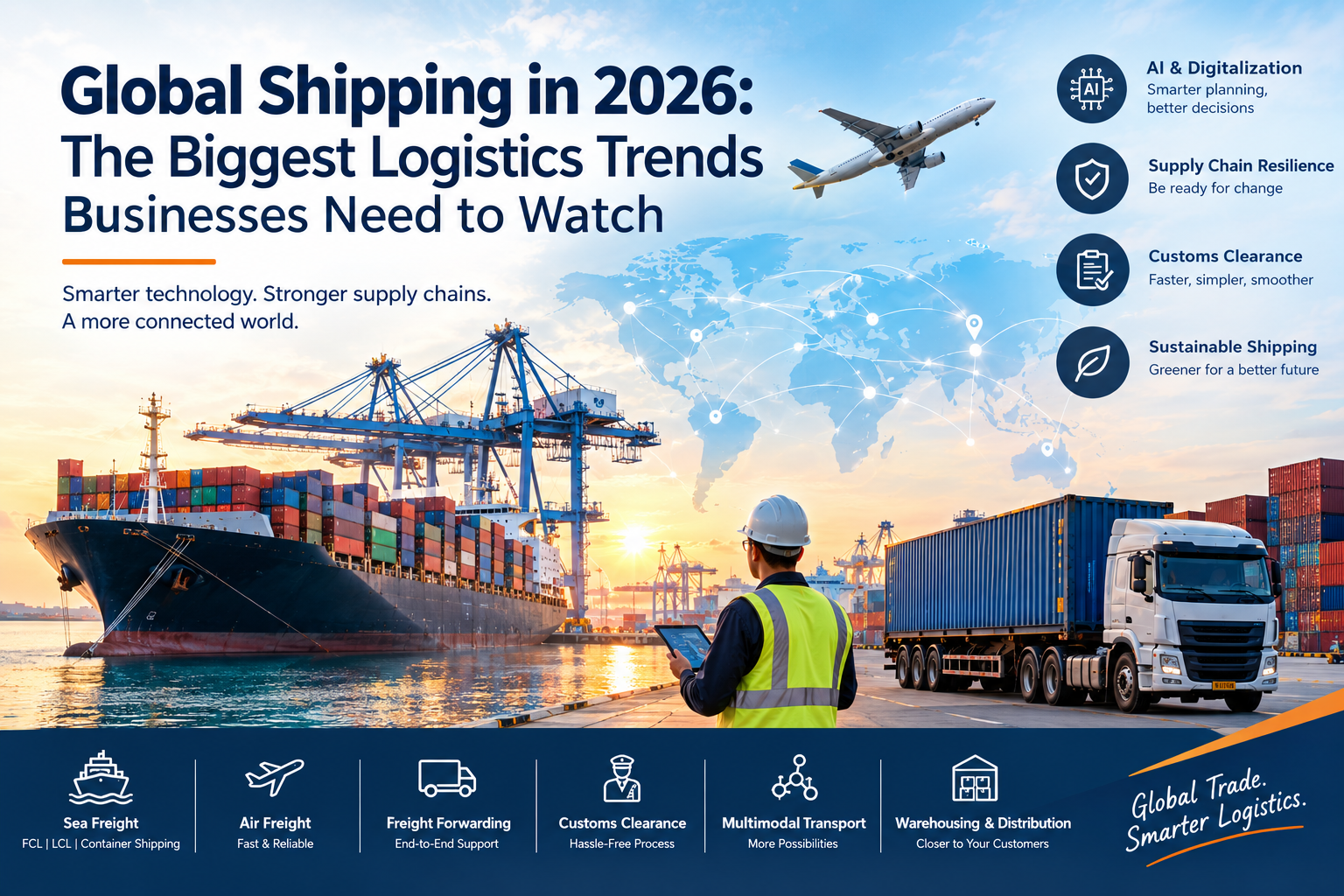
Global shipping has never been just about moving goods from one country to another. Behind every container arriving at a port, every urgent air freight delivery and every product reaching a warehouse is a chain of decisions involving suppliers, transport providers, customs authorities, inventory managers and customers.
In 2026, those decisions are becoming more complicated. Businesses are dealing with changing trade policies, unpredictable shipping routes, pressure to control freight costs and growing expectations for accurate shipment updates. At the same time, technology is creating new ways to plan transportation, manage documentation and identify problems before they disrupt deliveries.
For Indian exporters, importers, manufacturers and international traders, these changes are particularly important. Companies are exploring new markets, diversifying suppliers and looking for dependable freight forwarding services that can connect domestic operations with international destinations.
The question is no longer simply which shipping method offers the lowest rate. Businesses also need to consider how reliably their cargo will move, whether the documentation is correct, how quickly customs clearance can be completed and what happens if a planned route becomes unavailable.
This guide explores the biggest global shipping and logistics trends in 2026, explains how they affect everyday business decisions and outlines practical steps companies can take to prepare.
1. Supply Chain Resilience Is Becoming More Important Than the Cheapest Route
For many years, businesses built their supply chains around cost efficiency. They often preferred a single supplier, a familiar shipping route and the lowest available transportation rate.
That approach can work when conditions remain stable. The difficulty begins when a port becomes congested, a trade restriction changes, a supplier misses a production deadline or a shipping route experiences disruption.
In those situations, a company that relies on one source or one transportation option may have very few alternatives.
Supply chain resilience means preparing for these possibilities before they become urgent problems. Businesses are increasingly looking at alternative suppliers, additional transport routes, carefully planned inventory levels and logistics partners that can help them respond when circumstances change.
India reflects this wider shift. A 2026 report from DP World, based on a survey of Indian supply chain and logistics executives, found that 70% of respondents were prioritising supplier diversification, while 59% were increasing inventory levels to prepare for disruption.
These figures suggest that companies are thinking beyond the immediate freight charge and paying closer attention to the continuity of their operations.
Consider an Indian manufacturer importing electronic components from a single overseas supplier. If that supplier cannot dispatch an order on time, production may slow down even when customer demand remains strong. Having an approved alternative supplier or a realistic backup shipping plan can reduce the impact.
Businesses do not necessarily need to hold excessive inventory or duplicate every supplier relationship. They need to identify which goods are essential, understand the consequences of a delay and decide where a backup arrangement is worth the additional cost.
What businesses should do: Identify critical products, review supplier concentration, map alternative shipping routes and establish a clear escalation process for delayed shipments. A modest amount of preparation can prevent a relatively small transport problem from affecting the entire business.
2. Artificial Intelligence Is Changing Logistics Planning
Artificial intelligence is moving from experimental projects into practical supply chain operations. In 2026, logistics businesses are exploring how AI can support route planning, demand forecasting, shipment tracking, documentation checks and exception management.
The real value is not simply that a system can generate a report. It is that better information can help people make decisions earlier.
For example, a business might receive an alert that a shipment is likely to miss its planned connection. Instead of waiting until the cargo has already been delayed, the logistics team can examine alternative sailings, review the delivery deadline and decide whether a different arrangement is necessary.
AI can also help identify patterns in historical freight data. A company that imports goods regularly may be able to compare seasonal demand, transit times and previous delays to make more informed booking decisions.
In freight forwarding, potential applications include:
- Analysing shipping schedules and possible route disruptions.
- Comparing freight quotations and service options.
- Flagging missing or inconsistent shipment information.
- Supporting demand forecasting and inventory planning.
- Helping customer service teams respond to routine enquiries.
- Identifying unusual shipment delays for further investigation.
However, AI is not a substitute for experienced logistics professionals. A system may provide a recommendation based on incomplete information, outdated schedules or incorrect data. Customs classification, regulatory interpretation and complex cargo planning still require appropriate human oversight.
Businesses should also consider data privacy, system integration and accountability before allowing automated tools to make important operational decisions.
What businesses should do: Begin with a specific problem, such as reducing documentation errors or improving shipment visibility. Measure the results before expanding the system. Useful technology should make logistics decisions clearer and faster, not introduce another disconnected platform.
3. Real-Time Shipment Visibility Is Becoming a Business Requirement
Customers increasingly want to know where their cargo is, whether it has cleared customs and when it is likely to arrive.
A booking confirmation is useful, but it does not tell the full story. Between the initial pickup and final delivery, cargo may pass through several warehouses, terminals, transport providers and border procedures.
When information is scattered across emails, spreadsheets and different tracking websites, it becomes difficult to understand the shipment’s actual position.
Shipment visibility brings these updates together. Depending on the service and available data, a business may be able to view booking confirmation, cargo collection, departure, arrival, customs status and final delivery milestones.
Better visibility is valuable for more than customer reassurance. It helps purchasing teams plan production, warehouse managers organise receiving space and sales teams communicate realistic delivery expectations.
Imagine a retailer importing seasonal products before a major sales period. If the shipment’s arrival changes, the retailer needs to know early enough to adjust warehouse staffing, stock allocation or promotional plans. An update received after the expected delivery date offers much less practical value.
It is important to distinguish genuine tracking information from estimated arrival dates. A projected arrival is a forecast, not a guarantee, and updates may depend on the carrier or service provider supplying accurate information.
What businesses should do: Ask their freight forwarder which shipment milestones are available, how often information is updated and who will communicate significant changes. Keep shipment references, documentation and contact details organised so that issues can be investigated without unnecessary delay.
4. Global Shipping Routes and Trade Relationships Are Evolving
International shipping routes are influenced by much more than distance. Port capacity, geopolitical developments, trade agreements, fuel costs, infrastructure, customs procedures and local regulations can all affect the route a shipment takes.
In 2026, businesses are paying closer attention to where their goods are manufactured and how those goods reach their final markets. Some are diversifying suppliers across different countries, while others are reviewing regional distribution networks or exploring new trading relationships.
UN Trade and Development has highlighted the reconfiguration of global value chains as businesses respond to geopolitical risks, industrial policies and technological change.
For Indian companies, this creates both opportunities and planning challenges. New supplier relationships and export markets can support growth, but each route comes with its own transit times, documentation requirements, transport connections and cost structure.
A company sourcing machinery from one country and components from another may need to coordinate several shipments with different delivery dates. The cheapest route for each individual consignment may not always be the best option for the overall production schedule.
Businesses should also avoid assuming that a familiar route will always remain the most suitable. A change in service frequency, port congestion or border requirements can alter the practical advantages of a particular shipping lane.
Route diversification does not mean switching routes constantly. It means understanding the alternatives and knowing when they make commercial sense.
What businesses should do: Review the origin and destination of important shipments, assess dependence on individual trade corridors and ask logistics partners about realistic alternatives. Compare the complete journey, including inland transport and customs clearance, rather than looking only at the ocean or air freight segment.
5. Customs Clearance and Trade Compliance Need Earlier Attention
Customs clearance has always been part of international shipping, but it deserves even greater attention when businesses operate across multiple markets with different rules and documentation requirements.
A shipment may arrive at its destination on schedule and still be delayed because a document is missing, a product description is unclear, a declared value requires clarification or an applicable permit has not been arranged.
These issues can lead to additional storage charges, missed delivery appointments and uncertainty about when the goods will become available.
Customs clearance involves the procedures required for goods to enter or leave a country legally. Depending on the shipment and jurisdiction, these procedures may include customs declarations, tariff classification, valuation, assessment of duties and taxes, verification of origin and checks for licences or regulatory approvals.
For Indian importers and exporters, the specific requirements can vary according to the goods, country of origin, destination, applicable trade agreements and current regulations.
What documents are commonly needed for customs clearance?
The exact list depends on the transaction, but common documents may include:
- Commercial invoice.
- Packing list.
- Bill of lading or air waybill.
- Import or export customs declaration.
- Importer Exporter Code (IEC) details where applicable to Indian trade.
- Certificate of origin, where required or relevant to a preferential tariff claim.
- Product-specific licences, permits or certificates where applicable.
- Other supporting documents requested by customs authorities.
Incorrect paperwork can create problems even when every physical package has been packed correctly. For instance, inconsistent quantities across an invoice and packing list may prompt additional questions. An incorrect tariff classification can also affect the calculation of duties and the regulatory requirements applied to a product.
Businesses should not treat customs clearance as a task that begins only after cargo reaches the port. Classification, documentation and compliance checks are often best addressed before dispatch.
Digital customs processes are also developing. In June 2026, the World Customs Organization reported the launch of a digital ATA Carnet process by an initial group of customs administrations, including the European Union, Norway, Switzerland and the United Kingdom. This is an example of how specific cross-border procedures are moving towards digital documentation, although adoption and eligibility vary by country and process.
What businesses should do: Prepare documents early, use consistent product descriptions and values, confirm applicable permits and work with an experienced customs broker or freight forwarder. Never assume that a document or exemption accepted for one shipment will automatically apply to another.
6. Air Freight and Sea Freight Decisions Are Becoming More Strategic
Air freight and sea freight continue to serve different business needs. The choice depends on the urgency of the shipment, its size, weight, value, destination and the consequences of a delay.
Air freight is often considered for urgent deliveries, high-value goods, samples, electronics and products with short commercial windows. Sea freight is frequently suitable for larger volumes, heavy cargo and shipments where a longer transit time can be accommodated.
Within sea freight, Full Container Load (FCL) shipping allows a shipment to use an entire container, while Less than Container Load (LCL) consolidation allows compatible consignments from different shippers to share container space.
For smaller importers and exporters, LCL consolidation can make international sea freight more accessible when their cargo does not justify a full container. FCL shipping may be more practical when shipment volumes are larger or when the cargo requires dedicated container space.
The decision should not be based on the headline freight rate alone. A sea shipment may have a lower transportation charge but require a longer planning window. An urgent air shipment may cost more, yet prevent a costly production stoppage or missed sales opportunity.
Businesses should consider the full landed cost, which may include pickup, freight, insurance, customs duties and taxes, terminal handling, documentation, storage and final delivery.
They should also allow for the time required to collect cargo, complete export procedures, clear customs at destination and transport the shipment to its final address.
What businesses should do: Compare air freight, sea freight and multimodal transportation using the same cargo details and delivery requirements. Ask for a breakdown of charges, realistic transit estimates and any exclusions before confirming a booking.
7. Multimodal Transportation Is Helping Connect More Complex Supply Chains
A shipment rarely travels entirely by one mode of transport from the supplier’s door to the buyer’s warehouse.
Cargo may move by truck to a seaport, by ship across an ocean, by rail through an inland network and by road for final delivery. Combining modes can help businesses connect locations that are not served efficiently by a single transport option.
Multimodal transportation is particularly relevant when companies need to balance cost, transit time, infrastructure availability and the location of their suppliers or customers.
For example, an exporter located inland in India may need road transportation to reach a port before the cargo begins its international sea journey. The receiving business may then arrange rail or road transport from the destination port to a distribution centre.
The challenge is coordinating these stages. A missed connection at one point can affect the rest of the journey, especially when schedules, documents and handling responsibilities are managed separately.
Complex or specialised shipments may need additional planning. Oversized cargo, heavy machinery and non-containerised goods can require route surveys, lifting equipment, special permits and suitable handling facilities.
In these cases, a coordinated logistics plan helps align transport capacity, cargo dimensions, loading arrangements, delivery windows and customs requirements.
What businesses should do: Ask for a clear route plan showing each transport stage, expected handover points, documentation responsibilities and contingency arrangements. Confirm that equipment and infrastructure are suitable for the actual cargo, rather than relying only on a general service description.
8. Sustainability Is Becoming Part of Freight Procurement
Environmental considerations are increasingly appearing in supply chain planning, reporting and purchasing decisions.
For logistics, the challenge is practical: businesses need to move goods reliably while understanding the environmental impact of different transportation choices. The most suitable option depends on shipment characteristics, available services and delivery deadlines.
For some cargo, sea freight may offer a lower transport-related emissions intensity than air freight, but comparisons depend on the route, load factor, equipment and calculation method. A shipment’s full environmental footprint may also include warehousing, packaging, inland transport and other activities.
Businesses are examining options such as better container utilisation, improved route planning, fewer unnecessary trips, more efficient packaging and the use of lower-emission transport services where available.
Consolidation can also improve space utilisation when compatible shipments can be grouped efficiently. However, the benefit depends on the actual movement and handling requirements, not simply the fact that cargo shares a container.
Environmental reporting is another consideration. Companies selling to international customers may be asked to provide information about transport emissions or other supply chain impacts. The availability and quality of the underlying data matter if that information is to support credible reporting.
Sustainability requirements can also overlap with market access and regulatory compliance. Businesses should monitor rules relevant to their products and trading partners rather than assuming that one standard applies everywhere.
What businesses should do: Ask logistics providers whether they can supply credible emissions information, review opportunities to improve cargo utilisation and compare transport options against both delivery needs and environmental objectives. Avoid making broad sustainability claims without a reliable basis.
9. Warehousing and Inventory Planning Are Becoming More Flexible
Warehousing is no longer simply a place to keep goods until an order arrives. It can be an important part of a company’s strategy for managing delivery times, protecting inventory and responding to changes in demand.
When businesses expand into new markets, they must decide where stock should be held and how it will reach customers. Keeping all inventory at one location may be simple, but it can create longer delivery times or expose the company to a single point of disruption.
Some companies are reviewing regional distribution centres, fulfilment arrangements and inventory buffers for products that are essential to their operations. Others are trying to improve demand forecasting so they can avoid both stock shortages and excessive inventory.
There is no single answer for every business. Holding more stock can provide protection against delays, but it also ties up working capital and increases storage costs. Holding too little can leave a company vulnerable when supply or transportation is disrupted.
The right balance depends on demand patterns, supplier reliability, product shelf life, lead times and the cost of running out of stock.
For Indian importers, warehouse location can also influence the final delivery plan. Cargo arriving through a port may need to travel inland before reaching a manufacturing facility, retailer or fulfilment centre. A warehouse closer to the customer is not automatically cheaper if the storage and handling charges are significantly higher.
What businesses should do: Categorise inventory by importance, review actual demand and lead-time data, and calculate the cost of both excess stock and shortages. Coordinate purchasing, warehousing and freight decisions instead of managing each function separately.
10. Freight Costs Require More Careful Comparison
Freight costs can change with demand, available capacity, fuel expenses, carrier schedules, route conditions and other market factors. As a result, a quotation that looks attractive today may not represent the total cost of moving cargo through every stage of the supply chain.
Businesses need to understand the difference between the main transportation charge and the full cost of getting goods to their final destination.
Depending on the service, additional charges may include pickup, export handling, terminal handling, customs brokerage, documentation, storage, delivery, special equipment and applicable duties or taxes.
Cargo dimensions can also matter. Air freight charges may be based on chargeable weight, which considers both actual and volumetric weight under the carrier’s applicable rules. For sea freight, shipment volume, container type, origin and destination services can influence the quotation.
Unclear quotations create avoidable disputes. One provider may quote port-to-port transportation, while another includes customs clearance and delivery to the consignee’s premises. Comparing the headline totals without checking the scope can lead to the wrong decision.
Long-term freight contracts are not always the best option for every shipment, and spot rates are not always the cheapest overall. The right approach depends on shipment frequency, volume predictability, service requirements and the flexibility a business needs.
What businesses should do: Provide accurate cargo details, request itemised quotations, clarify the service scope and ask which charges could change. Compare realistic end-to-end costs and delivery commitments rather than selecting a provider on price alone.
11. Cybersecurity and Accurate Data Matter More Than Ever
As shipping and supply chain operations become more digital, businesses rely on online booking systems, electronic documents, tracking platforms and communication between multiple organisations.
These connections make information easier to share, but they also create risks. Fraudulent payment instructions, compromised email accounts, fake shipment updates and unauthorised access to business systems can disrupt operations or expose confidential information.
A change to bank details sent through an email that appears to come from a familiar supplier can be particularly dangerous. Similarly, inaccurate shipment data can affect customs declarations, bookings, warehouse planning and customer communications.
Cybersecurity is therefore not just an IT issue. It can influence whether cargo is released, whether payments reach the correct recipient and whether a company can continue operating during a disruption.
Businesses should also understand which partners can access their shipment and customer information, how that information is protected and what happens if a system becomes unavailable.
What businesses should do: Verify payment-detail changes through a separate trusted channel, restrict system access to authorised users, maintain reliable backups and train employees to recognise suspicious messages. Check the accuracy of shipment information before submitting documents or sharing it with partners.
12. Logistics Partnerships Are Becoming More Valuable
As international shipping involves more data, regulations and handovers, businesses increasingly need logistics partners that can help coordinate the entire movement rather than simply book a vessel or aircraft.
A reliable freight forwarding partner should be able to explain the available transport options, identify documentation requirements, coordinate customs clearance and provide realistic information about the shipment’s progress.
The level of support required will vary. A business sending occasional samples may need a straightforward shipping arrangement. An importer moving goods every week may benefit from a more structured process for bookings, documentation, tracking and freight cost reviews.
Specialised cargo requires another level of planning. Heavy machinery, oversized cargo, break bulk shipments and project cargo may need detailed loading plans, suitable equipment, route checks and coordination among several transport providers.
Clear responsibilities are important in all these cases. Businesses should know who handles export documentation, who coordinates destination customs procedures, who arranges final delivery and whom to contact when a shipment does not follow the expected schedule.
A logistics partner cannot eliminate every risk. What matters is having a workable plan, clear communication and the ability to respond when conditions change.
What businesses should do: Evaluate logistics providers on service scope, experience with similar cargo, communication, documentation support and problem-solving—not just price. Agree on responsibilities and escalation contacts before the first shipment moves.
How Businesses Can Prepare for the Rest of 2026
The trends discussed above may appear separate, but they are closely connected. Better shipment visibility supports faster decisions. Accurate digital documentation can help reduce avoidable customs issues. Alternative suppliers and transport routes can improve resilience. Careful freight comparisons can protect margins without compromising delivery requirements.
Businesses do not need to adopt every new technology or redesign their entire supply chain at once. A practical starting point is to review where delays, unexpected costs and communication problems occur most often.
A simple review can cover five areas:
First, review shipping performance. Compare planned and actual transit times, identify recurring delays and determine which routes or suppliers create the greatest risk.
Second, check customs readiness. Review document accuracy, tariff classification, applicable permits and the timing of customs preparation. Address recurring errors before the next shipment.
Third, improve shipment visibility. Make sure the people responsible for purchasing, inventory and customer commitments receive timely updates when delivery dates change.
Fourth, compare total logistics costs. Review freight, handling, storage, duties, taxes and final delivery charges together. Look for avoidable expenses rather than focusing exclusively on the main freight rate.
Finally, establish contingency plans. Decide what the business will do if a supplier misses a deadline, a route becomes unavailable or cargo is held for additional checks.
These steps are useful for both smaller importers and larger international businesses. The objective is to build a supply chain that can respond to change without turning every disruption into an emergency.
Global shipping in 2026 is being shaped by a combination of technology, changing trade relationships, tighter compliance expectations and the need for more dependable supply chains.
Businesses that pay attention to these developments can make better decisions about suppliers, transport modes, customs documentation, inventory and logistics partnerships. The aim is not to predict every disruption. It is to understand the risks, prepare realistic alternatives and make informed decisions when circumstances change.
For Indian businesses trading internationally, this means treating freight forwarding and customs clearance as important parts of commercial planning rather than tasks to arrange at the last minute.
DivineSeair Logistics supports businesses with air freight, sea freight, FCL shipping, LCL consolidation, customs clearance and multimodal transportation solutions. Whether you are importing materials, exporting finished goods or planning a more complex cargo movement, a well-organised shipping plan begins with accurate cargo details, clear delivery requirements and the right preparation before dispatch.