International trade has always depended on movement. Raw materials travel from one continent to another, manufacturers rely on components produced thousands of kilometres away, and finished products cross borders before reaching distributors, retailers and customers. Behind this movement is a global freight forwarding network that connects shipping lines, airlines, ports, customs authorities, warehouses and road transport providers.
For a long time, businesses could plan international shipments around familiar trade routes, established suppliers and relatively predictable transit schedules. That approach is becoming harder to maintain.
Geopolitical developments now influence decisions that were once treated as routine logistics matters. A conflict near an important shipping lane, a new trade restriction, sanctions against a company, a change in import duties or rising tensions between trading nations can alter the movement of cargo across several regions.
The effects are not limited to the countries directly involved. A disruption in one part of the world can affect container availability in another, increase freight costs on distant trade lanes and delay deliveries for businesses that have no direct connection to the original event.
This is why geopolitical risk has become an important consideration in international freight forwarding. Businesses need to look beyond the quoted freight rate and understand how political developments can affect routing, documentation, customs clearance, insurance and the reliability of their supply chains.
This article explores how geopolitical risk is changing the freight forwarding industry, what it means for international businesses and how importers and exporters can prepare for an increasingly complex trading environment.
1. Global Shipping Routes Are No Longer as Predictable
One of the clearest effects of geopolitical tension is the changing movement of ships across major maritime routes.
International shipping depends on a relatively small number of important waterways. The Suez Canal, Red Sea, Strait of Hormuz, Strait of Malacca and Panama Canal all play significant roles in connecting international markets.
When security concerns emerge around one of these routes, shipping companies must decide whether to continue using the usual passage or select an alternative.
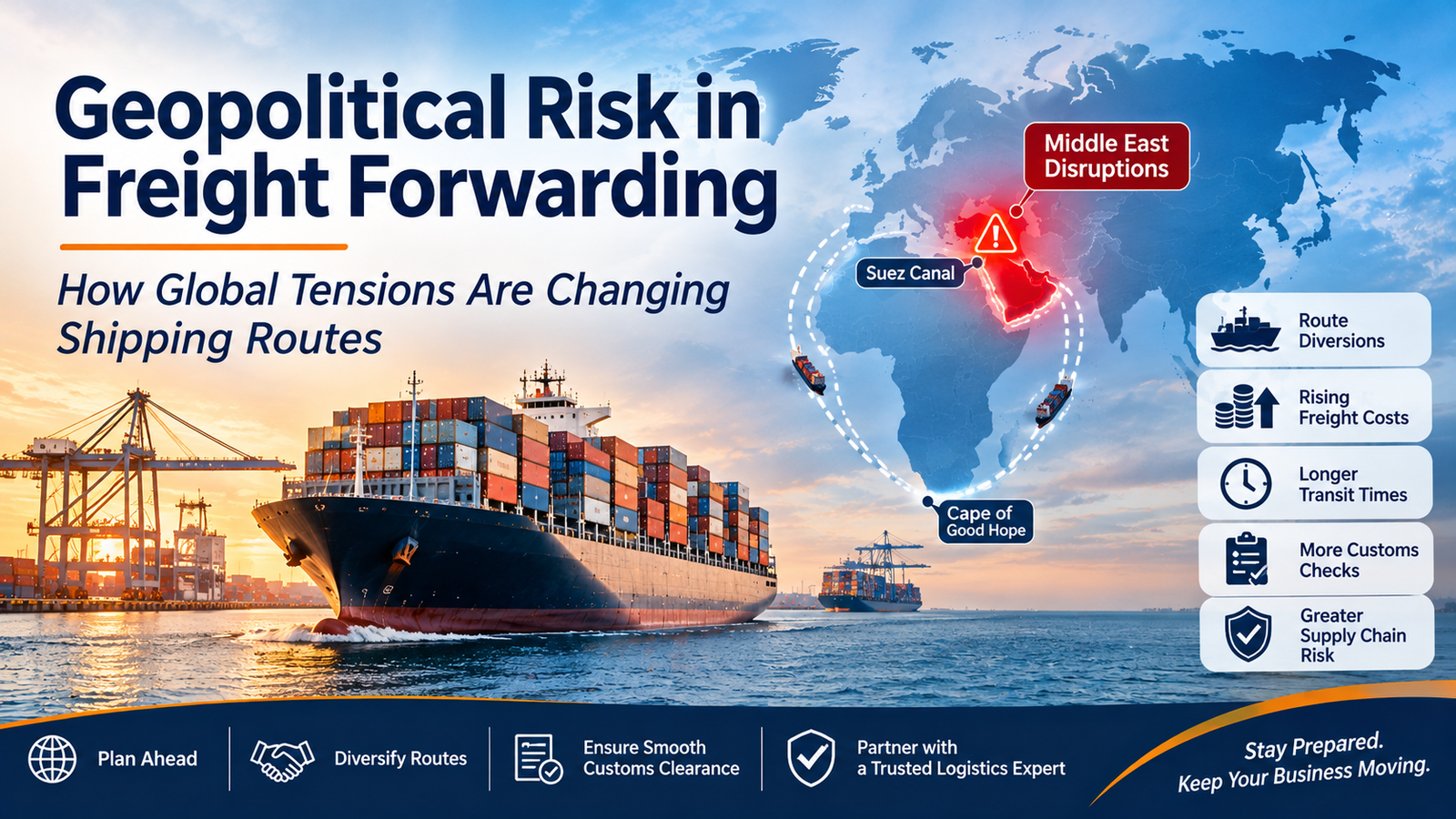
The Red Sea and Suez Canal situation provides a good example. Security threats have encouraged some shipping lines to divert vessels around the Cape of Good Hope in southern Africa. This adds distance to Asia–Europe journeys and can affect vessel schedules, fuel consumption and container availability.
The Strait of Hormuz presents a different challenge because of its importance to energy transportation and commercial shipping serving the Gulf region. The International Maritime Organization reported in August 2026 that the situation had left thousands of seafarers facing prolonged uncertainty, with verified attacks on international shipping during the conflict.
For freight forwarders, the practical challenge is deciding which route is suitable for each shipment. A route that is available to one carrier may not be used by another. Insurance conditions, port operations and the nature of the cargo can also influence the decision.
What businesses should do: Confirm the actual vessel routing before dispatch, allow realistic transit time and ask whether the quoted service includes transshipment or alternative port arrangements.
3. Trade Restrictions and Tariffs Are Changing Shipping Decisions
Geopolitical risk does not always involve armed conflict. Changes in trade policy can be just as important for freight forwarding.
Governments may introduce additional import duties, export restrictions, sanctions or licensing requirements in response to political and economic developments. These measures can change which products businesses are allowed to trade, where goods can be shipped and which parties can participate in a transaction.
For a freight forwarder, this creates a compliance responsibility that goes beyond arranging transportation.
A shipment may have a confirmed booking and a planned departure date, but that does not automatically mean it can legally be exported or imported. The product, buyer, seller, end user, country of origin and destination may all need to be checked against applicable regulations.
Sanctions are particularly important. Restrictions can apply to specific countries, organisations, individuals, vessels, financial institutions or categories of goods. A company should not assume that a transaction is permitted simply because the cargo itself is not prohibited.
Tariff changes can also affect commercial decisions. Businesses may reconsider their sourcing locations, change the timing of imports or explore alternative markets when duties make an established trade relationship less attractive.
UN Trade and Development has identified rising protectionism, geopolitical tensions and changing global value chains as important forces reshaping international trade in 2026.
What businesses should do: Check current trade restrictions before confirming a shipment, verify the parties involved in the transaction and seek qualified compliance advice when goods or destinations are subject to additional controls.
4. Customs Clearance Is Becoming More Complex
Customs clearance is one of the most important stages of international freight forwarding. It is also an area where geopolitical developments can create additional complications.
Customs authorities need accurate information about goods entering or leaving their countries. This includes the product description, classification, value, origin, quantity and applicable regulatory requirements.
When trade policies change, businesses may need to provide additional documentation or demonstrate that their shipment complies with new restrictions.
For example, a product may qualify for a preferential duty rate under a trade agreement, but the importer may need appropriate origin documentation to claim that benefit. A change in tariff treatment or country-of-origin requirements can affect the final amount payable.
A shipment may also require additional checks if it involves controlled goods, restricted destinations or parties subject to sanctions.
Common documents required for customs clearance
Depending on the shipment and destination, the documents may include:
- Commercial invoice.
- Packing list.
- Bill of lading or air waybill.
- Customs import or export declaration.
- Certificate of origin, where applicable.
- Import or export licences and permits, where required.
- Product-specific certificates or inspection documents.
- Supporting information for valuation and tariff classification.
For Indian importers and exporters, documentation may also involve the applicable Importer Exporter Code (IEC), shipping bill, Bill of Entry and other requirements under Indian customs procedures.
The exact documentation depends on the product, country, transaction and applicable regulations. A document accepted for one destination should not automatically be assumed to satisfy another country’s requirements.
Why early customs planning matters
Imagine an exporter sending industrial components to an overseas buyer. A new restriction or documentation requirement comes into effect before the shipment arrives. If the exporter and importer have not checked the updated rules, the cargo may face additional scrutiny or remain on hold while supporting documents are arranged.
This can result in storage charges, delayed delivery and uncertainty for the buyer.
Customs clearance should therefore be considered during the planning stage, not only after cargo reaches the destination port.
What businesses should do: Confirm product classification, declared value, origin documentation and applicable permits before dispatch. Work with an experienced customs broker or freight forwarder when regulations are unclear or have recently changed.
5. Supply Chains Are Moving Towards Diversification
Geopolitical developments have encouraged businesses to reconsider where they source products and how dependent they are on individual suppliers.
A company that relies on one manufacturing location may face difficulties if political tensions, export restrictions or transport disruptions affect that region.
This has increased interest in supply chain diversification. Businesses are exploring additional sourcing markets, alternative manufacturing locations and different transportation routes.
The China+1 strategy is one example of this wider approach. Companies that previously depended heavily on Chinese manufacturing have considered expanding production or sourcing relationships in countries such as India, Vietnam and other Southeast Asian markets.
India has opportunities in this changing environment, particularly in manufacturing, engineering goods, pharmaceuticals, textiles and other export sectors.
However, changing suppliers is not as simple as selecting another country. Businesses must evaluate product quality, production capacity, regulatory requirements, transport infrastructure, customs procedures and the reliability of local logistics services.
A new supplier may offer a competitive production price but operate through a port with limited shipping connections. Another supplier may be geographically closer but require more complicated documentation.
What businesses should do: Identify critical products, assess dependence on individual suppliers and compare alternative sourcing locations using both manufacturing and logistics costs.
6. Marine Insurance and Cargo Risk Management Are Receiving More Attention
When a shipment travels through a region affected by geopolitical tension, the financial risk can extend beyond the value of the freight.
Cargo may be exposed to physical damage, loss, delay or additional handling requirements. Shipowners and cargo owners may also face increased insurance costs when a route is considered higher risk.
Marine cargo insurance helps protect goods against specified risks during transportation, subject to the policy conditions, exclusions and limits.
War-risk coverage is a separate consideration. Businesses should not assume that a standard cargo insurance policy automatically covers every consequence of armed conflict or political instability.
The route itself can matter. A change in vessel routing, transshipment location or storage arrangement may require notification to the insurer.
This is particularly important for high-value machinery, electronics, pharmaceutical products and industrial cargo. A relatively small insurance misunderstanding can create a significant financial problem when something goes wrong.
Freight forwarders can help coordinate shipping information and documentation, but businesses should review insurance coverage with their insurer or broker rather than relying on assumptions.
What businesses should do: Check the policy’s geographical limits, war-risk provisions, exclusions and notification requirements before dispatch. Keep a record of the agreed route and any changes made during transit.
7. Air Freight and Multimodal Transportation Are Becoming Important Alternatives
When sea freight routes become uncertain, businesses may consider other transportation options.
Air freight can be useful for urgent shipments, high-value products, samples, critical components and goods with short delivery windows. It can reduce transit time, although costs are generally higher for comparable cargo.
However, air freight is not completely separate from geopolitical risk. Airspace restrictions, airport closures, security measures and revised flight schedules can affect cargo operations.
Multimodal transportation is another option. It combines different transport modes, such as road, rail, sea and air, to move cargo between origin and destination.
For example, a shipment may travel by road from a manufacturing facility to an inland container depot, continue by rail to a seaport and then move by sea to its overseas destination.
In some situations, an alternative port or inland corridor may provide greater flexibility than relying on one route.
The right choice depends on the cargo’s dimensions, weight, value, delivery deadline and destination infrastructure. Heavy machinery may require specialised transport arrangements, while smaller consignments may be suitable for air freight or LCL consolidation.
What businesses should do: Ask their logistics provider to compare available routes and transport modes. Evaluate the complete journey, including customs clearance, terminal handling and final delivery, before changing the original shipping plan.
8. Digital Tracking and Supply Chain Visibility Are Becoming Essential
When international shipping conditions are uncertain, businesses need reliable information about their cargo.
A shipment may leave the origin port on time but experience a revised sailing schedule, transshipment delay or change of destination. Without timely updates, the importer may not know whether to adjust warehouse planning or inform customers about a revised delivery date.
Digital shipment tracking and supply chain visibility tools help bring important updates together.
Depending on the platform and available carrier information, businesses may be able to monitor:
- Cargo pickup and departure.
- Vessel or flight details.
- Port arrival and transshipment.
- Customs clearance status.
- Estimated delivery date.
- Final proof of delivery.
Technology can also help logistics teams identify unusual delays and communicate with carriers before the issue becomes more serious.
However, digital tracking is only useful when the underlying information is accurate. An estimated arrival date is not a guaranteed delivery date, and tracking systems may not always reflect every operational change immediately.
What businesses should do: Work with logistics providers that offer clear shipment updates, defined communication channels and prompt notification when routes or schedules change.
9. Freight Forwarders Are Taking on a More Strategic Role
Traditionally, many businesses viewed freight forwarding as a service focused mainly on booking cargo space and arranging transportation.
That role is expanding.
Freight forwarders now need to consider how geopolitical developments affect route selection, carrier availability, documentation, customs requirements, insurance and final delivery.
A good logistics partner should be able to explain the options available when the original plan becomes unsuitable. This may involve an alternative shipping line, a different port, an air freight arrangement or a revised multimodal route.
The forwarder also needs to coordinate with multiple parties. A shipment may involve the exporter, importer, shipping line, customs broker, port operator, warehouse and inland transport provider. If responsibilities are unclear, even a manageable delay can become difficult to resolve.
This is particularly important for project logistics, oversized cargo and break bulk shipments. These movements may require specialised equipment, route surveys, lifting arrangements, permits and close coordination at both origin and destination.
For businesses with regular international shipments, a freight forwarding partner can also help review recurring problems and identify improvements in booking, documentation and cost management.
What businesses should do: Choose a provider based on international experience, communication, customs knowledge, service coverage and the ability to manage unexpected changes—not simply the lowest quoted rate.
10. What Geopolitical Risk Means for Indian Importers and Exporters
India is closely connected to international supply chains through imports of energy, machinery, electronics, chemicals and industrial materials, as well as exports of pharmaceuticals, engineering goods, textiles, agricultural products and manufactured products.
Geopolitical developments can therefore affect Indian businesses in several ways.
A disruption in the Gulf may influence energy-related shipping and insurance costs. A change in European or American trade policy may affect export competitiveness. Restrictions involving particular trading partners may require businesses to review their sourcing and compliance arrangements.
In 2026, the Government of India has highlighted the impact of West Asia developments on freight movement, insurance costs, delivery schedules and exporters’ working capital cycles. Its response has included inter-ministerial coordination, attention to customs-related bottlenecks and examination of alternative routing arrangements.
For smaller exporters, the challenge can be particularly serious. A large company may have several suppliers, multiple logistics partners and the financial capacity to absorb unexpected charges. A small exporter working with a narrow margin may have much less flexibility.
This makes early planning and reliable logistics coordination especially important.
What businesses should do: Monitor trade advisories, review destination-country requirements, keep customs documentation accurate and maintain communication with freight forwarders, customs brokers and overseas buyers.
How Can Businesses Prepare for Geopolitical Shipping Risks?
No business can control international political developments. It can, however, reduce its exposure by improving how it plans and manages shipments.
A practical approach includes the following:
- Review important trade routes: Identify the ports, waterways and transport corridors used by critical shipments. Understand which alternatives are available.
- Diversify suppliers where practical: Avoid unnecessary dependence on a single supplier or manufacturing location for essential products.
- Prepare customs documentation early: Check product classification, valuation, origin and permit requirements before cargo is dispatched.
- Understand freight charges: Ask about surcharges, insurance costs, storage and possible expenses if a route changes.
- Review cargo insurance: Confirm the coverage available for the planned route and understand any relevant exclusions.
- Maintain shipment visibility: Request regular updates and agree on who will communicate delays or changes.
- Plan alternative transport: Consider air freight, sea freight and multimodal transportation according to the cargo and delivery deadline.
- Communicate with customers: Share realistic delivery estimates and inform buyers promptly when a disruption affects the shipment.
- Keep commercial records: Retain booking confirmations, invoices, transport documents, customs records and communications about route changes.
- Work with experienced logistics partners: Choose providers who understand international freight forwarding, customs clearance and the operational challenges of changing trade conditions.
These measures will not eliminate geopolitical risk, but they can help businesses respond with greater confidence and avoid preventable disruption.
Geopolitical risk is no longer something that international businesses can treat as a distant political issue. It has become part of everyday freight forwarding decisions.
A change in one region can affect shipping routes, freight rates, insurance conditions and customs procedures across several continents. The consequences may reach a manufacturer waiting for imported components, an exporter trying to meet a delivery deadline or a retailer planning its next inventory cycle.
The businesses best prepared for these conditions are not necessarily those that spend the most on transportation. They are the ones that understand their supply chains, keep their documentation in order, monitor changing conditions and have realistic alternatives when the original plan no longer works.
At Divine Sea Air Logistics, we understand that international cargo movement requires more than arranging a vessel or aircraft. Our freight and logistics solutions include air freight, sea freight, FCL shipping, LCL consolidation, customs clearance, multimodal transportation, break bulk cargo and project logistics.
Whether your business is importing materials, exporting finished products or managing a specialised international shipment, careful planning and the right logistics support can help keep your cargo moving in an uncertain global trading environment.