Imagine spending months preparing for an international exhibition. Your team has designed an impressive booth, your product samples are ready, and your sales team has booked meetings with potential customers. Then, a few days before the event, you discover that your display equipment is still waiting for customs clearance or your shipment has arrived at the wrong exhibition warehouse.
It is a situation no exhibitor wants to face, yet it highlights an important part of participating in trade fairs: the logistics behind the event.
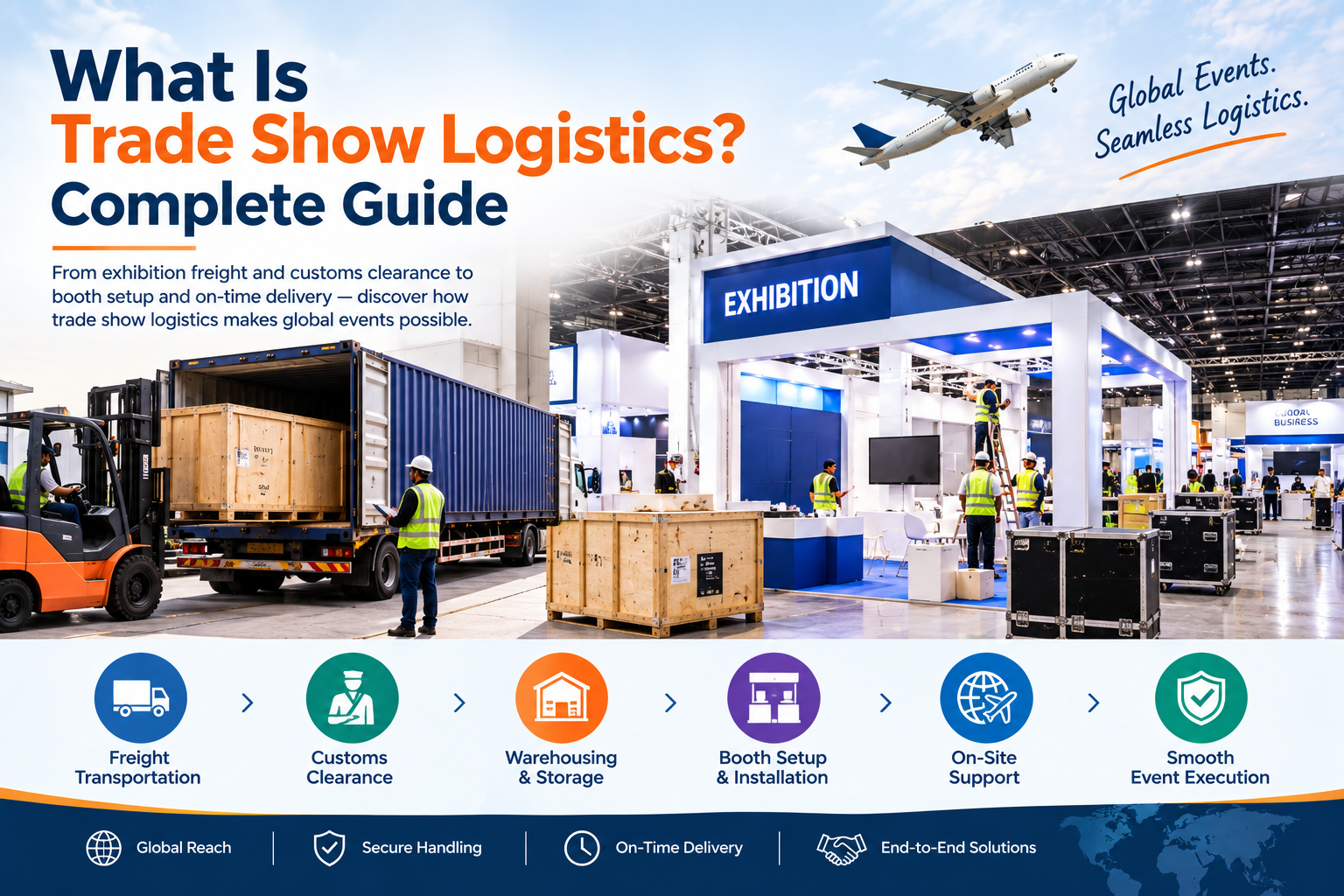
Trade show logistics involves much more than transporting products from one location to another. It brings together freight forwarding, exhibition shipping, customs clearance, warehousing, delivery scheduling, booth installation support and the movement of goods after the event. Every part needs to work together because exhibition cargo usually has a fixed deadline and very little room for delay.
For businesses participating in exhibitions in India or overseas, understanding trade show logistics can make the difference between a well-organised event and an expensive last-minute problem.
What Is Trade Show Logistics?
Trade show logistics is the planning, transportation, handling and delivery of materials required for exhibitions, trade fairs, conventions, product launches and business events.
These materials may include product samples, display stands, promotional merchandise, demonstration machinery, lighting equipment, exhibition furniture, marketing materials and technical equipment.
Unlike regular commercial shipping, exhibition freight is connected to a specific event schedule. Cargo must reach the correct venue, follow the organiser’s delivery instructions and be available before the exhibition opens. In many cases, the same goods must be collected and shipped back to their country of origin once the event finishes.
For an international exhibitor, the process may involve several parties: the manufacturer, freight forwarder, customs broker, airline or shipping line, local transport provider, exhibition organiser and booth contractor.
Trade show logistics brings these moving parts together so that the exhibitor can focus on meeting customers, demonstrating products and building business relationships.
Why Is Trade Show Logistics Important?
Exhibitions are time-sensitive by nature. A shipment that arrives one day late may be of little use if the event lasts only three days. Even when the cargo reaches the destination country on time, it can still miss the deadline if customs formalities, terminal handling or venue delivery arrangements have not been planned properly.
Consider a company exhibiting industrial equipment at a manufacturing trade fair in Germany. The machinery may need a special vehicle for transportation, careful handling at the airport and a scheduled delivery slot at the exhibition centre. If any of these arrangements is missed, the company could face additional storage charges, urgent transport costs or an incomplete booth.
Well-planned exhibition logistics helps businesses:
- Deliver exhibition materials before the official setup deadline.
- Reduce the risk of customs delays and missing documentation.
- Coordinate international freight and local transportation.
- Protect valuable products, samples and display equipment.
- Manage return shipments after the event.
- Control freight, storage, handling and other logistics expenses.
- Avoid unnecessary disruption to the exhibition schedule.
The goal is not simply to move cargo. It is to make sure the right materials reach the right place, in usable condition, at the time they are needed.
What Does Trade Show Logistics Include?
The requirements depend on the event, destination and type of cargo. A small display of consumer products may need straightforward air freight, while a large industrial exhibition can require several transport modes, specialised handling and advance customs planning.
1. Exhibition Freight and International Shipping
Exhibition freight covers the transportation of goods from the exhibitor’s warehouse or factory to the exhibition venue or designated event warehouse.
The most suitable shipping method depends on the shipment’s size, weight, value, urgency and destination.
Air freight is often considered when products are time-sensitive, relatively compact or valuable. It can be useful for samples, electronics, urgent promotional material and equipment needed shortly before an event.
Sea freight may be more suitable for large, heavy or less time-sensitive shipments. Full Container Load (FCL) shipping can accommodate larger consignments, while Less than Container Load (LCL) consolidation allows businesses to share container space when their cargo does not fill an entire container.
Multimodal transportation can connect ports, airports, warehouses and exhibition venues. A shipment might travel by sea to the destination country and then by road to the event location.
The best option is not always the fastest service available. It is the transport plan that meets the event deadline while balancing cost, cargo requirements and the time needed for customs clearance and final delivery.
2. Customs Clearance for Exhibition Cargo
Customs clearance is one of the most important parts of international trade show logistics.
When goods cross an international border, customs authorities may require declarations, supporting documents, applicable duties and taxes, permits or other regulatory checks. Exhibition cargo can involve additional considerations because the goods may enter a country temporarily for display or demonstration rather than for permanent sale.
For example, an Indian manufacturer sending machinery samples to an overseas exhibition must establish how the goods will be declared, whether any special permissions are required and how the equipment will return after the event.
Common documents may include:
- Commercial invoice or pro forma invoice, as appropriate.
- Detailed packing list.
- Air waybill or bill of lading.
- Customs declaration and applicable import/export documentation.
- Product descriptions, quantities and values.
- Country-of-origin information, where required.
- Permits, certificates or licences for regulated goods, where applicable.
- Temporary import or re-export documents, when relevant.
The exact requirements vary by country, product and shipment arrangement. A freight forwarder or customs broker can help identify the documentation needed before dispatch and coordinate the clearance process.
What Is an ATA Carnet in Trade Show Logistics?
An ATA Carnet is an international customs document that can facilitate the temporary admission of eligible goods, including certain commercial samples, professional equipment and exhibition materials. It may allow qualifying goods to enter participating countries temporarily without payment of import duties and taxes, subject to the applicable conditions.
However, an ATA Carnet is not a universal solution for every exhibition shipment. Eligibility depends on the goods, destination, intended use and rules of the countries involved. Consumable items, goods intended for sale and other ineligible categories may require a different customs procedure.
Businesses must also follow the required re-export process and ensure the carnet is correctly presented and endorsed at the relevant customs points. Failure to meet the conditions can result in duties, taxes or penalties.
Indian businesses should verify current requirements with the relevant customs authorities and the authorised ATA Carnet issuing organisation before shipping exhibition goods.
3. Exhibition Warehousing and Storage
Not every shipment can be delivered directly to a booth as soon as it reaches the destination.
Some exhibitions operate designated freight warehouses that receive cargo before the event. The shipment may be stored until the organiser’s permitted delivery window opens. Other events have strict rules about when vehicles can enter the venue and when exhibitors can begin setting up.
Exhibition warehousing can help manage these arrangements, especially when cargo arrives in different consignments or needs to be consolidated before final delivery.
Storage planning should account for the event’s receiving deadlines, handling charges, security requirements and collection procedures. It is also important to confirm whether the warehouse accepts the type and dimensions of the cargo being shipped.
4. Booth Setup and On-Site Delivery
Getting cargo to the exhibition city is only part of the job. The materials must reach the correct hall, stand number or receiving area.
Some shipments contain fragile displays, large structures or machinery that cannot be moved using ordinary handling equipment. Others require careful separation because different components belong to the same booth.
A coordinated delivery plan considers vehicle access, unloading arrangements, venue restrictions, labour availability and the time needed for installation.
For large exhibitions, the logistics provider may need to coordinate with the official exhibition freight handler or organiser. Following the venue’s delivery instructions helps avoid missed slots, unnecessary handling and delays during setup.
5. Return Shipping After the Exhibition
The logistics process does not finish when the event closes.
Goods may need to be packed, collected, inventoried and returned to the original country. Alternatively, some materials may move to another exhibition, a local warehouse or a customer’s premises.
Return logistics should be planned before the initial shipment leaves. This is particularly important for temporarily imported goods because customs authorities may require proof of re-export within a prescribed period.
Businesses should also distinguish between reusable equipment, promotional materials that will be consumed, goods sold during the event and items intended for disposal. Each category may have different customs and documentation implications.
How Does Trade Show Logistics Work?
Although every exhibition has its own requirements, a typical shipment follows a sequence of planning, transportation, clearance and delivery.
Step 1: Understand the event requirements
Start by confirming the exhibition dates, venue, booth number, official freight deadlines, cargo acceptance rules and delivery address. The organiser’s exhibitor manual is an important reference.
Step 2: Prepare the cargo details
Provide accurate dimensions, gross weight, quantity, product descriptions, declared values and packing details. Photographs or technical specifications may be helpful for unusual equipment.
Step 3: Select the shipping method
Choose between air freight, sea freight, road transportation or a multimodal solution. Allow enough time for transit, customs clearance and delivery to the exhibition site.
Step 4: Complete documentation and customs planning
Determine the applicable import and export requirements. If the shipment is temporary, establish the appropriate procedure for admission and subsequent re-export before the goods leave the origin country.
Step 5: Arrange transportation and handling
Coordinate pickup, export formalities, main-carriage transportation, destination handling and any required warehousing.
Step 6: Deliver within the venue’s permitted window
Confirm the receiving location, delivery slot, unloading requirements and contact person. Track the shipment and communicate any changes that could affect the setup schedule.
Step 7: Organise collection and return
After the exhibition, arrange packing, collection, return freight and any required customs formalities. Keep the documents and records needed to close the shipment correctly.
Starting this process early gives the business more choices and reduces dependence on expensive last-minute arrangements.
How Much Does Trade Show Logistics Cost?
There is no single price for exhibition logistics. Costs depend on the cargo, origin, destination, service level and event requirements.
The main cost components may include:
- Pickup and export handling.
- Air freight or sea freight charges.
- Fuel and security surcharges, where applicable.
- Customs brokerage and clearance fees.
- Duties and taxes, if payable.
- Terminal handling and documentation charges.
- Exhibition warehouse receiving and storage fees.
- Delivery to the venue and unloading.
- Special handling, lifting equipment or dedicated vehicles.
- Cargo insurance.
- Return transportation and re-export formalities.
Air freight may cost more than sea freight for comparable cargo, but a lower ocean freight rate does not automatically mean a lower total cost. Longer transit times, storage, additional handling and event deadlines all influence the final decision.
A useful way to compare quotations is to check exactly what each price includes. One quotation may cover only international transportation, while another may include customs clearance, destination handling and delivery to the exhibition warehouse.
Ask for a breakdown of included services, exclusions, possible surcharges and return-shipment costs before making a decision.
Common Trade Show Shipping Problems and How to Avoid Them
Exhibition cargo often faces predictable problems that can be reduced through preparation.
Late dispatch: Businesses sometimes plan around the exhibition opening date rather than the earlier freight-receiving deadline. Work backwards from the organiser’s cutoff and allow time for customs clearance and unexpected delays.
Incorrect documents: Vague product descriptions, inconsistent values or missing supporting paperwork can trigger questions from customs authorities. Check the documents against the physical packing list before dispatch.
Unplanned temporary imports: Goods sent for display may need to leave the destination country under specific customs conditions. Decide how the shipment will be cleared on arrival and how it will be re-exported.
Unexpected venue charges: Exhibition centres may apply special handling, storage or delivery rules. Read the exhibitor manual and confirm the charges before booking transportation.
Poor packing: Exhibition equipment may be handled multiple times during international transportation and venue delivery. Use suitable export packaging, label each package clearly and protect fragile components.
No return plan: Waiting until the last day of the event to organise collection can create avoidable delays. Book the return movement in advance and clarify who is responsible for packing, collection and customs paperwork.
The common thread is simple: many logistics problems begin before the cargo moves. Better preparation is often more valuable than trying to solve everything after a shipment is delayed.
Trade Show Logistics in India: What Businesses Should Know
Indian exporters and manufacturers regularly participate in domestic and international exhibitions to introduce products, find distributors and develop new business relationships.
For an Indian company exhibiting overseas, the logistics plan may involve export documentation, international freight, destination-country customs clearance and delivery to the exhibition venue. If the goods are expected to return to India, the business must also consider the re-import process and retain the relevant shipping and customs records.
Foreign exhibitors bringing goods to India face their own requirements. The applicable procedure depends on whether the goods are temporary exhibition items, commercial samples, products intended for sale or equipment subject to special controls.
For eligible temporary exhibition goods, the ATA Carnet system may be an option, but the business should confirm eligibility, customs acceptance and re-export conditions in advance. The Directorate General of Foreign Trade has also issued guidance concerning exhibits and samples, so the applicable rules should be checked for the specific shipment and event.
Businesses should pay particular attention to:
- The exhibition organiser’s official freight and delivery instructions.
- Correct product descriptions, values and packing details.
- Applicable customs procedures and permits.
- The time required for clearance and final delivery.
- Re-export or return-shipment deadlines.
- The responsibilities of the freight forwarder, customs broker and exhibitor.
Planning should begin as soon as the exhibitor confirms participation, rather than waiting until the booth materials are ready to leave the warehouse.
How to Choose a Trade Show Logistics Company
A suitable logistics company should understand both international freight forwarding and the practical requirements of exhibition venues.
Ask potential providers whether they have experience with similar events, destinations and cargo types. A company accustomed to ordinary commercial shipments may still need additional planning to handle strict exhibition deadlines, venue-specific procedures or temporary imports.
Look for a provider that can explain the proposed shipping route, document requirements, customs arrangements, delivery milestones and return plan in clear terms.
It is also worth checking how shipment updates will be communicated, who will manage issues at the destination and whether the quotation includes the services you actually need.
For shipments involving heavy machinery, large displays or sensitive equipment, ask about packing standards, handling arrangements and suitable transportation options.
The lowest quotation is not always the safest choice when a missed delivery could affect an entire exhibition. Reliability, clear communication and realistic scheduling deserve serious consideration.
How Project Logistics Can Support Complex Exhibitions
Some exhibitions feature large industrial machinery, oversized product displays or equipment that requires specialised lifting and transportation. These shipments need more planning than standard cartons or promotional materials.
In such cases, project logistics can help coordinate route surveys, equipment requirements, permits, specialised handling and delivery schedules across multiple transport stages. The precise services required depend on the cargo, destination and venue restrictions.