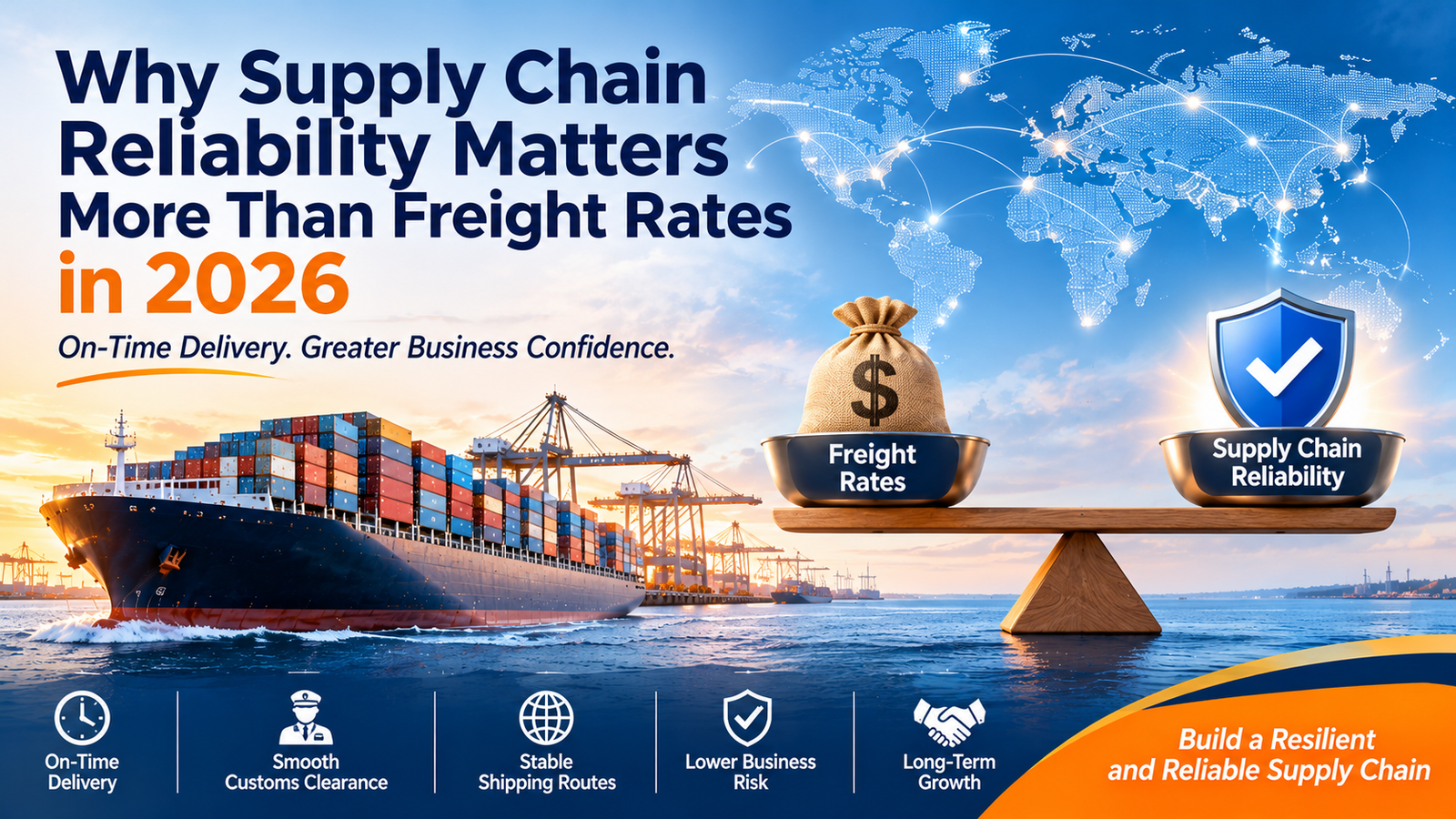
For many years, freight procurement has revolved around one familiar question: How much will it cost to move the shipment? Importers and exporters compare quotations, negotiate with shipping lines, evaluate air freight and sea freight options, and try to secure the lowest possible transportation cost.
In 2026, however, another question deserves equal attention: Can the shipment reach its destination when the business actually needs it?
A competitive freight rate may look attractive on a quotation, but the real cost of transportation does not end with the amount paid to a freight forwarder. A delayed container can interrupt production, leave warehouse shelves empty, cause a missed delivery commitment, increase inventory expenses and damage a company’s relationship with its customers.
This is why supply chain reliability is becoming a major consideration in international trade. Businesses are recognising that predictable transportation, accurate shipment information, efficient customs clearance and dependable logistics partners can be more valuable than saving a small amount on freight.
The shift is particularly relevant in 2026, when international supply chains continue to face changing trade policies, geopolitical uncertainty, port congestion, weather-related disruption and fluctuating transportation costs. For businesses operating across India, Europe, the Middle East, Asia-Pacific and North America, reliability is no longer simply an operational preference. It is part of staying competitive.
1. The Lowest Freight Rate Does Not Always Mean the Lowest Cost
Imagine an Indian manufacturer importing essential components from an overseas supplier. Two freight quotations arrive.
The first is cheaper, but the service has an uncertain sailing schedule, limited shipment updates and a longer estimated transit time. The second costs slightly more but offers a more dependable sailing arrangement, better communication and clearer coordination at the destination.
At first glance, choosing the cheaper option may appear to be a sensible financial decision. But what happens if the shipment arrives two weeks late?
The manufacturer may have to slow down production, purchase replacement materials locally at a higher price or delay an order for its own customer. The savings achieved during freight negotiation can quickly disappear.
This is the difference between freight cost and total logistics cost.
A company’s actual transportation expenses may include:
- Ocean freight or air freight charges
- Origin and destination handling
- Customs duties and taxes
- Customs clearance and documentation costs
- Port storage and container detention charges
- Demurrage and additional handling
- Warehousing and inventory expenses
- Production downtime caused by missing materials
- Costs associated with missed delivery commitments
Not every delayed shipment creates all these expenses. However, businesses should consider the possibility before selecting a service based only on its quoted freight rate.
The better decision is not automatically the most expensive option. It is the option that offers the right balance of cost, transit time, operational control and reliability.
This shift also reflects the growing importance of supply chain resilience in ocean freight, where dependable schedules and the ability to respond to disruption can matter as much as the initial transportation price.
2. Global Shipping Has Become More Difficult to Predict
International shipping depends on a network of ports, vessels, airports, road connections, customs authorities, shipping lines, warehouses and local transport providers. A problem at one point can affect several other stages of the journey.
A vessel delayed at a busy port may miss its next scheduled connection. A change in shipping routes can extend transit times. Weather conditions can interrupt port operations, while geopolitical developments may affect vessel movements, insurance arrangements and freight availability.
These challenges are not limited to one region or trade lane.
In its January 2026 analysis, S&P Global highlighted how shipping customers are increasingly prioritising shipping reliability over freight rates, reflecting the growing importance of predictable transportation and dependable supply chain operations.
The wider message is straightforward: a shipment that moves at a predictable pace is often more useful to a business than one that is inexpensive but difficult to plan around.
For importers and exporters, this means evaluating shipping schedules, transit-time performance, carrier options and alternative routes before confirming a booking.
3. Delays Affect More Than the Shipment Itself
The World Bank also highlights how reliable logistics and international trade are closely connected, with predictable movement of goods helping businesses reduce costs and compete more effectively in global markets.
One of the biggest misunderstandings in logistics is treating a delay as a transportation problem alone.
In reality, a shipment is usually connected to several business activities. Imported machinery may be required for an installation project. Raw materials may be needed to maintain a production line. Retail goods may have to reach distribution centres before a seasonal sales period. Exhibition materials may need to arrive before an international trade show opens.
When cargo does not arrive as planned, the impact can spread across the organisation.
Consider a few common examples:
Manufacturing: A factory waiting for imported components may have to reschedule production or operate below capacity.
Retail and e-commerce: A delayed consignment can result in unavailable products, missed sales opportunities and disappointed customers.
Construction and infrastructure: Heavy equipment or project cargo arriving late may affect installation schedules and contractor commitments.
Pharmaceuticals and perishables: Temperature-sensitive or time-critical shipments may require additional monitoring, specialised handling and carefully planned transport arrangements.
Trade shows and exhibitions: Exhibition materials arriving after the event begins can undermine months of preparation.
In each situation, the business is affected by the reliability of the entire logistics process, not simply the price of the freight movement.
4. Customs Clearance Is a Critical Part of Supply Chain Reliability
A shipment can travel across an ocean on schedule and still fail to reach the consignee on time if its customs documentation is incomplete or inaccurate.
Customs clearance is therefore an essential part of reliable international freight forwarding.
Import and export procedures involve documentation, regulatory checks, classification of goods, valuation, duties and other compliance requirements. The exact requirements depend on the country, commodity, origin, destination and applicable trade regulations.
For Indian importers and exporters, documentation may include:
- Commercial invoice
- Packing list
- Bill of Lading or Air Waybill
- Shipping Bill for exports
- Bill of Entry for imports
- Certificate of Origin, where applicable
- Import Export Code (IEC), where required
- Product-specific licences, permits or certificates, where applicable
This is a general overview rather than a universal document checklist. Certain products and trade routes require additional approvals or regulatory documents.
Even a small discrepancy between the commercial invoice, packing list and transport documents can create questions during customs assessment. Incorrect product descriptions, classification issues, missing certificates or incomplete declarations may also lead to additional checks.
That is why customs clearance should not be treated as something to arrange only after the cargo reaches its destination.
Reliable logistics planning starts before dispatch. Businesses should confirm documentation requirements, share accurate shipment information and coordinate with their customs broker or logistics provider in advance.
A well-managed customs clearance process can reduce avoidable delays and help cargo move through the border formalities more smoothly. It also supports better planning for delivery, warehousing and onward transportation.
5. Shipment Visibility Makes Better Planning Possible
Businesses cannot manage what they cannot see.
When an importer receives no meaningful updates after a container leaves the origin port, planning becomes difficult. The receiving warehouse may not know when to arrange unloading. The production team may be uncertain about material availability. The sales department may struggle to give customers a dependable delivery estimate.
Shipment visibility helps solve this problem.
A useful tracking and communication process should provide updates at important stages, such as:
- Cargo pickup and receipt at origin
- Export documentation and customs status
- Vessel departure or flight departure
- Transshipment, where applicable
- Estimated arrival at destination
- Arrival and discharge confirmation
- Import customs clearance progress
- Final delivery status
Tracking technology is valuable, but visibility is not just about having a tracking link. Businesses also need meaningful updates when a schedule changes, an exception occurs or an action is required.
A logistics partner that communicates a delay early gives the customer more time to respond. The company may be able to adjust inventory, inform its buyer, arrange alternative transportation or revise production schedules.
In many cases, early information is more useful than a perfect-looking delivery estimate that is never updated.
6. Choosing the Right Freight Mode Is About More Than Price
Air freight, sea freight and multimodal transportation each serve different business requirements. The most suitable option depends on cargo characteristics, urgency, budget, destination and delivery commitments.
Sea freight is commonly used for larger consignments, heavy cargo and international container transportation. Businesses can choose between FCL shipping (Full Container Load) and LCL consolidation (Less than Container Load), depending on shipment volume and requirements.
However, the lowest ocean freight quotation should not be the only deciding factor. Sailing frequency, port congestion, transshipment arrangements, destination handling and schedule consistency all deserve attention.
Air freight is useful when delivery time is important, cargo has a high value-to-weight ratio or a production or sales commitment cannot wait for a longer sea journey.
Although air cargo usually costs more per unit of weight than sea freight, the wider business cost may be lower when speed prevents production interruption or a missed commercial deadline.
Multimodal Transportation
Multimodal transportation combines two or more modes of transport, such as road, rail, sea and air, to move cargo between locations.
It can offer practical alternatives when a direct route is unavailable, a destination has limited connectivity or a shipment requires a more coordinated transport plan.
FCL and LCL Consolidation
FCL shipping may suit businesses with sufficient cargo volume to use a full container, while LCL consolidation allows smaller consignments from different shippers to share container space.
The right choice depends on shipment size, handling requirements, transit schedules and total landed cost. Reliability also depends on consolidation cut-off times, deconsolidation arrangements and coordination at both ends.
The objective is to select a transportation method that supports the delivery requirement, rather than choosing one simply because its initial quotation is lower.
7. Reliable Logistics Partners Help Businesses Manage Uncertainty
International freight forwarding involves more than arranging space on a vessel or aircraft. It requires coordination between multiple parties, including carriers, customs brokers, port operators, transport providers, warehouses and consignees.
A dependable logistics partner helps bring these activities together.
When evaluating freight forwarding companies, businesses should look beyond the initial quotation and consider:
Communication: Does the provider respond clearly and provide timely shipment updates?
Operational knowledge: Can the team handle different cargo types, trade routes and documentation requirements?
Customs coordination: Can it support the customs clearance process and identify documentation requirements before dispatch?
Network capability: Does it have suitable origin and destination partners for the required route?
Problem-solving: When a vessel is delayed or a connection is missed, can the provider explain the available alternatives?
Service transparency: Are charges, responsibilities, estimated transit times and potential additional costs explained clearly?
A reliable freight forwarder does not control every external factor. No logistics provider can guarantee that ports will never become congested or that international shipping schedules will never change. What matters is how effectively the provider prepares for disruptions, communicates problems and coordinates practical solutions.
8. Supply Chain Reliability Is Becoming a Business Strategy in India
India’s role in international manufacturing, sourcing and exports makes dependable logistics increasingly important for businesses of different sizes.
Manufacturers importing components, exporters shipping finished products, engineering companies moving machinery and retailers sourcing international inventory all depend on the performance of transportation and border processes.
DP World’s Global Trade Observatory Annual Outlook Report 2026 draws on a survey of more than 3,500 supply chain and logistics executives worldwide. Its findings identify supplier diversification as a leading strategic priority for businesses responding to an uncertain trade environment.
The Government of India’s measures to safeguard trade and support exporters during West Asia disruptions also demonstrate why logistics continuity and coordinated trade support matter for Indian businesses.
The PIB source is an official government briefing published on 2 April 2026. Its actual headline is Inter-Ministerial Briefing on Recent Developments in West Asia, so use the descriptive anchor above rather than presenting it as the official article title.
For Indian businesses, this has practical implications.
An exporter shipping to Europe, the Middle East or Southeast Asia needs to consider sailing schedules, destination requirements and possible route changes. An importer bringing machinery into India needs to coordinate shipping, documentation, customs clearance and inland delivery. A company handling smaller shipments may benefit from carefully planned LCL consolidation rather than waiting until it has enough cargo for a full container.
Businesses should also consider whether they depend too heavily on one supplier, one shipping route or one logistics provider. Diversification does not mean changing partners constantly. It means understanding available alternatives before a disruption occurs.
9. Practical Ways to Improve Supply Chain Reliability in 2026
Improving reliability does not always require a complete redesign of the supply chain. Many improvements begin with better preparation and coordination.
Here are some practical steps businesses can take:
- Evaluate total logistics cost: Compare freight rates alongside possible storage, detention, inventory and delay-related expenses.
- Review carrier performance: Look at schedule consistency, transit-time history, route options and communication quality.
- Prepare customs documents early: Check commercial invoices, packing lists, product descriptions and applicable permits before cargo dispatch.
- Build realistic delivery timelines: Include time for origin handling, export formalities, transportation, transshipment, import customs clearance and final delivery.
- Maintain shipment visibility: Establish clear communication milestones and escalation procedures for delayed or diverted cargo.
- Identify alternative routes: Understand whether another port, carrier, airport or transport mode could be used if the original plan becomes unavailable.
- Review inventory requirements: Determine which materials are essential for uninterrupted production and whether safety stock is commercially justified.
- Work with capable logistics partners: Select providers based on operational support, experience, transparency and their ability to coordinate the complete shipment.
- Review performance regularly: Measure on-time delivery, customs delays, unexpected charges and the frequency of shipment exceptions.
- Plan for special cargo: Oversized cargo, break bulk cargo, project cargo and time-sensitive consignments may require additional surveys, equipment, permits and route planning.
These steps help transform logistics from a series of individual bookings into a more coordinated supply chain operation.
10. Making Supply Chain Reliability a Competitive Advantage
In international trade, a company’s reputation is built not only on the products it sells but also on its ability to deliver what it promises. Customers expect orders to arrive within agreed timelines. Manufacturing teams need materials when production schedules demand them. Distributors and retailers depend on consistent replenishment to serve their own markets.
When logistics operations are predictable, businesses can make better decisions across these activities. They can plan inventory with greater confidence, manage customer expectations, coordinate production and respond to changes without constantly reacting to unexpected shipment problems.
This is where supply chain reliability becomes a competitive advantage rather than simply an operational requirement.
It does not mean that businesses should ignore freight rates or always select the most expensive service. It means evaluating transportation decisions in the context of the entire business. A lower freight quotation may be the right choice when the route, schedule and service meet the shipment’s requirements. In other situations, paying a little more for dependable coordination, suitable transit times and better communication may protect a much larger commercial commitment.
For companies involved in global trade, the objective should be to build logistics arrangements that balance cost efficiency with consistency and control.
At DivineSeair Logistics, we understand that every shipment is connected to a wider business commitment. Our logistics services cover air freight, sea freight, FCL shipping, LCL consolidation, customs clearance, break bulk cargo, oversized and out-of-gauge cargo, multimodal transportation, project logistics, and trade shows and events logistics.
As global trade continues to evolve, businesses need logistics solutions that consider more than the freight quotation. They need a partner that understands the importance of coordination, communication and reliable cargo movement.
Because in international logistics, delivering with confidence can be worth far more than saving a little on freight.