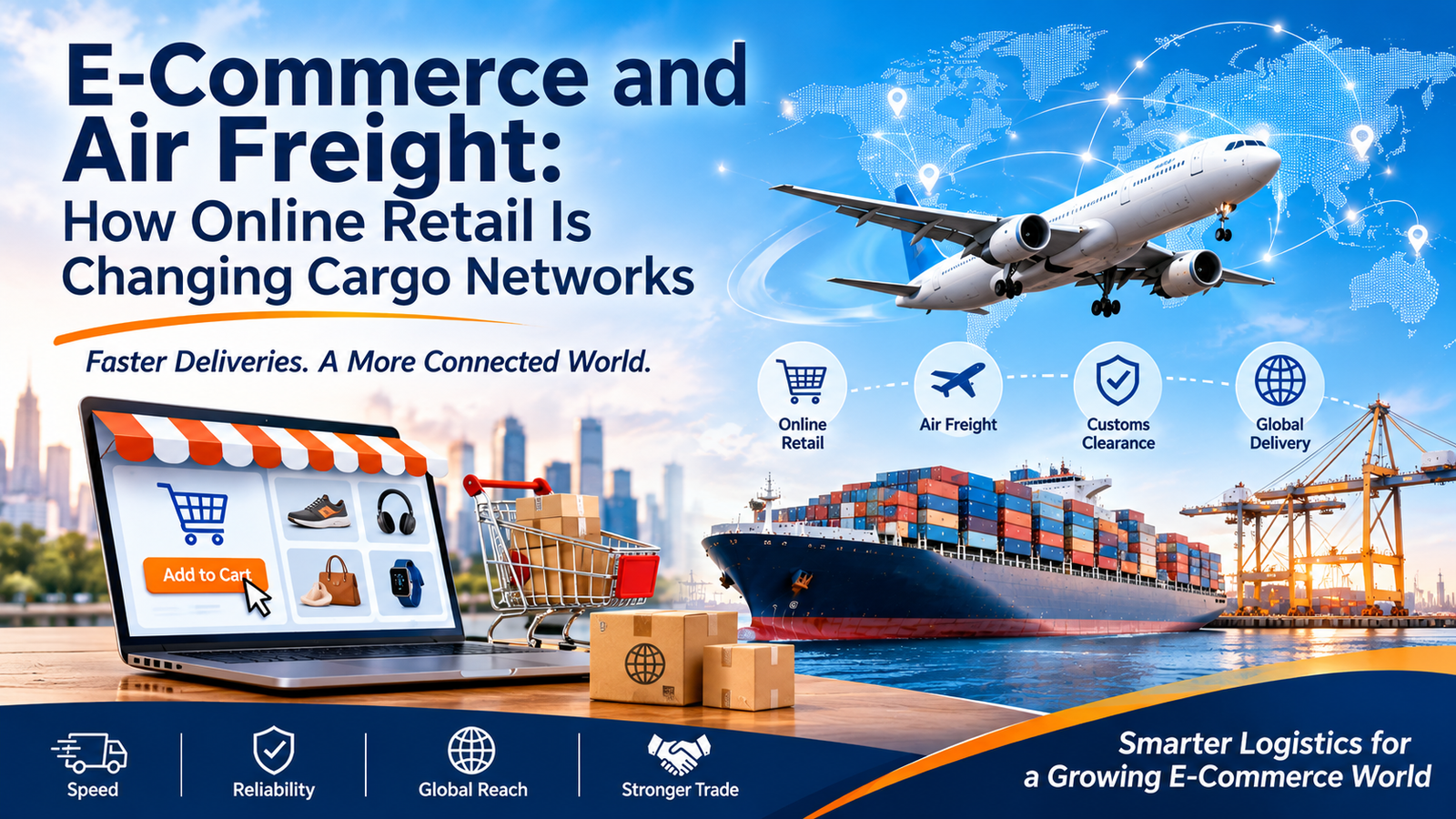
A customer in London orders a pair of shoes from an Indian online store. Another customer in Singapore purchases handmade products from a seller in Jaipur. Meanwhile, a retailer in the United States places an urgent order for electronic accessories manufactured in Asia.
These transactions may look like ordinary online purchases, but behind each one is a complex logistics operation. Products must be collected, sorted, packed, transported, cleared through customs and delivered across international borders, often within a relatively short period.
This is one of the reasons e-commerce has become an important force in the global air freight industry.
Online retail has changed what customers expect from businesses. People no longer want to wait weeks without knowing where their orders are. They expect accurate delivery estimates, shipment tracking, quick order processing and a straightforward returns experience. For retailers selling internationally, meeting these expectations requires a logistics network that can respond to thousands of individual orders rather than simply moving large shipments between warehouses.
Air freight has become an important part of that network. Its speed and international connectivity make it suitable for time-sensitive online orders, particularly when products need to travel between distant markets.
But the change goes beyond faster transportation. E-commerce is influencing how airlines allocate cargo capacity, how airports process parcels, how freight forwarders manage shipments and how customs authorities handle cross-border trade.
For Indian exporters, online sellers and international retailers, understanding this shift is becoming increasingly important.
1. How e-Commerce is Changing Air Cargo Logistics
Traditional cargo transportation was largely organised around commercial shipments moving between manufacturers, distributors, wholesalers and retailers. Shipments were often consolidated into larger consignments, with delivery schedules planned around inventory requirements.
E-commerce introduced a different pattern.
An online retailer may receive hundreds or thousands of orders from customers located in different countries. Each order has its own destination, delivery expectation and tracking requirement. Instead of moving only large commercial consignments, logistics networks must also handle a substantial number of smaller packages.
This creates a different operational challenge.
A single aircraft may carry cargo belonging to several retailers, marketplaces, courier companies and individual sellers. Once the aircraft reaches its destination, the shipments must be separated, processed through the relevant customs procedures and transferred into local delivery networks.
The International Air Transport Association (IATA) identifies air cargo as an essential part of cross-border e-commerce, highlighting the industry’s need to improve transportation speed, visibility, operational efficiency and coordination.
The result is a more connected cargo network in which airlines, freight forwarders, courier operators, customs authorities, fulfilment centres and online retailers increasingly depend on one another.
2. E-commerce’s Contribution To International Air Cargo Growth
The relationship between e-commerce and air freight is built around one basic requirement: getting products to customers within the expected delivery window.
Not every online order needs to travel by air. Large, non-urgent consignments may move by sea freight, while domestic deliveries generally depend on road and local distribution networks. However, air cargo becomes particularly valuable when delivery time, product value or international distance makes slower transportation less suitable.
Consider an Indian business selling fashion accessories to customers in Europe. If it receives a large order from an overseas distributor, sea freight may be a practical option. But if individual customers are ordering products online and expecting delivery within a shorter period, air freight or an integrated international courier service may be more appropriate.
The same applies to electronics, samples, specialised components, premium consumer products and certain time-sensitive goods.
According to Air Cargo Week’s reporting on 2025 air freight activity, e-commerce shipments transported by air reached approximately 5.4 million tonnes, representing around 18% of international air cargo volumes. This illustrates how online retail has become a significant part of international cargo demand.
The industry is therefore adapting its networks to accommodate a growing mix of commercial freight and individual e-commerce parcels.
3. July 2026 Global Air Cargo Market Analysis
The traditional cargo network was designed primarily around moving freight between major manufacturing and distribution centres. E-commerce has introduced more destinations, smaller shipments and tighter delivery expectations.
This has changed several parts of the transportation process.
More direct connections between markets
Online retailers increasingly want to serve customers in countries where they do not operate physical stores. This creates demand for international air cargo connections between manufacturing locations, fulfilment centres and consumer markets.
Greater demand for parcel processing
Airports and cargo terminals must handle a higher number of individual packages, each requiring accurate identification, sorting and shipment information.
Changing aircraft capacity requirements
Airlines need to balance passenger aircraft belly capacity, dedicated freighter operations and changing cargo demand across different trade lanes.
More complex shipment consolidation
Freight forwarders and logistics providers must combine individual parcels into larger transport movements while maintaining visibility of each shipment.
Greater importance of destination networks
An international shipment does not finish when an aircraft lands. Cargo must still be sorted, cleared through customs and transferred to the appropriate local delivery network.
These changes mean that air freight is increasingly part of a wider e-commerce fulfilment system rather than a standalone transportation service.
4. Why Delivery Speed Matters to Online Retailers
For an online retailer, delivery time can influence whether a customer completes a purchase, returns to the website or chooses a competing seller.
A customer purchasing a product from another country may compare several sellers offering similar products. If one seller provides a more dependable delivery estimate and better shipment tracking, that can influence the buying decision.
Air freight helps retailers manage certain time-sensitive deliveries, particularly when products are moving across long international distances.
It can be useful for:
- Fashion and lifestyle products
- Electronic accessories and components
- Premium consumer goods
- Product samples
- Urgent replacement parts
- High-value commercial consignments
- Seasonal and promotional merchandise
However, faster transportation alone does not guarantee faster delivery.
Cargo still needs to be collected, prepared, processed at the origin airport, transported, cleared by customs and handed over for final delivery. A delay in any of these stages can affect the promised delivery date.
This is why online retailers need to consider the complete transportation process rather than looking only at the flight duration.
5. Customs Clearance: A Major Part of Cross-Border E-Commerce
One of the most important challenges in international e-commerce is customs clearance.
When an online customer purchases a product from another country, the package must comply with the import regulations of the destination market. The shipment may need a customs declaration, accurate product description, value information, applicable tariff classification and other supporting details.
For businesses shipping hundreds or thousands of parcels internationally, managing this information accurately becomes a significant operational responsibility.
Common information and documents used in international e-commerce shipments include:
- Commercial invoice or other appropriate value documentation
- Air Waybill
- Packing list, where applicable
- Product description and declared value
- Country of origin information
- Customs declaration data
- Applicable licences, permits or certificates
- Other product-specific regulatory documents
Requirements differ between countries and may depend on the commodity, shipment value, intended use and import regime.
Incorrect product descriptions, undervaluation, incomplete declarations or missing permits can result in customs queries, additional checks, duties or delayed delivery.
For Indian exporters, customs compliance is especially important when shipping products to multiple international destinations. Each market may have different import requirements, tax arrangements and restrictions.
The growth of e-commerce is also encouraging customs authorities to review how low-value parcels and courier shipments are processed.
In India, the Central Board of Indirect Taxes and Customs (CBIC) operationalised e-commerce export and courier trade reforms from 1 April 2026. These included removing the ₹10 lakh cap on courier export consignments and introducing measures to simplify the handling of returned and rejected shipments. The changes are intended to support e-commerce exporters, including MSMEs, artisans and start-ups.
This is an important development for Indian businesses looking to expand through international online marketplaces and direct-to-consumer sales.
Efficient customs clearance is not simply about completing paperwork. It is about preparing accurate shipment information and coordinating the necessary procedures before cargo reaches the destination.
6. India’s e-Commerce Export And Courier Trade Reforms
India has a diverse manufacturing and business ecosystem, with products ranging from textiles, garments and handicrafts to engineering goods, electronics, accessories and speciality products.
For many smaller businesses, online marketplaces have created an opportunity to reach customers outside their traditional domestic markets.
An artisan in Rajasthan can sell handmade products to an overseas buyer. A clothing manufacturer in Delhi can receive orders from customers in Europe. A speciality products business in Mumbai can develop an international customer base without opening a physical retail outlet in every country.
However, reaching international customers requires more than an online store.
Businesses need to manage export documentation, product compliance, packaging, transportation costs, customs clearance, delivery tracking and returns.
Air freight and international courier services can help connect Indian sellers with overseas markets, particularly for smaller and time-sensitive orders.
The 2026 CBIC reforms are also relevant because they aim to make courier-based e-commerce exports more flexible and reduce certain procedural barriers.
For Indian MSMEs and start-ups, this creates an opportunity to think beyond domestic online sales and explore international e-commerce markets with a better understanding of the logistics involved.
7. Air Freight Versus Sea Freight for E-Commerce Shipments
Choosing between air freight and sea freight depends on the type of product, order volume, delivery expectation and total landed cost.
Air Freight
Air freight is suitable for urgent shipments, smaller commercial consignments and products where delivery time is an important consideration.
Its advantages include:
- Shorter transportation time over long distances
- Access to international airport networks
- Suitability for high-value and time-sensitive goods
- Greater flexibility for certain urgent replenishment requirements
Its main limitation is cost. Air freight generally has a higher transportation cost per unit of weight than sea freight, so it may not be suitable for every product or order.
Sea Freight
Sea freight is often more suitable for larger consignments, bulk inventory and products that do not require immediate delivery.
It can help online retailers replenish fulfilment centres and distribution warehouses with larger quantities of stock.
Businesses may choose FCL shipping when they have sufficient cargo volume for a dedicated container, or LCL consolidation when smaller consignments can share container space.
A Combined Transportation Strategy
Many international retailers use a combination of transportation modes.
For example, a business may move its regular inventory by sea freight while using air freight for urgent replenishment or unexpected demand.
This approach can help balance transportation costs with product availability and delivery expectations.
8. The Role of Freight Forwarders in E-Commerce Logistics
E-commerce cargo involves several transportation and operational stages. Coordinating these activities becomes more complicated when shipments are moving between multiple countries.
A freight forwarder can help businesses organise the international movement of cargo and coordinate with the relevant transportation and logistics partners.
Depending on the agreed service arrangement, this may include:
Air cargo booking: Arranging suitable air freight capacity according to cargo requirements and delivery timelines.
Shipment consolidation: Combining multiple consignments for more efficient transportation where appropriate.
Export documentation: Coordinating the necessary shipment information and export formalities.
Customs clearance coordination: Supporting the customs process through appropriate brokers or authorised representatives.
International transportation: Coordinating cargo movement between origin and destination markets.
Shipment visibility: Providing updates about important shipment milestones and operational changes.
Destination coordination: Working with local logistics partners to arrange cargo handling and onward transportation.
For online retailers, these services can help connect the different parts of an international shipping operation.
The most suitable logistics partner is one that understands the shipment’s requirements, communicates clearly and can coordinate the necessary services without creating unnecessary complexity.
9. 2026 Air Cargo Technology Trends
Online shopping has made customers accustomed to receiving order confirmations, tracking updates and estimated delivery dates.
The same expectations are now influencing international air cargo operations.
Retailers want to know when cargo has been collected, when it has departed, whether it has reached the destination airport and whether customs clearance has been completed.
Technology can make this information easier to manage.
Digital booking systems, electronic shipment documentation, tracking platforms and automated data exchange help improve communication between airlines, freight forwarders, courier companies and online retailers.
However, technology is useful only when the information is accurate and shared at the right time.
A tracking system that continues to display an outdated delivery estimate does not help a retailer manage customer expectations. What businesses need is reliable information about shipment progress, delays and the actions required to resolve operational issues.
For logistics providers, digital integration is becoming an important part of supporting the growing requirements of cross-border e-commerce.
10. The Challenges Ahead for E-Commerce Air Freight
Although online retail creates new opportunities for air cargo, it also introduces challenges that the industry must address.
Rising transportation costs: Fuel prices, capacity limitations and seasonal demand can affect air freight rates.
Customs and regulatory changes: Different countries may introduce new requirements for low-value imports, product declarations and parcel processing.
Returns management: International returns can be expensive and operationally complicated, particularly when products cross multiple borders.
Cargo security: High parcel volumes require appropriate screening, handling and shipment information.
Environmental considerations: Faster air transportation has a different environmental footprint from sea freight, encouraging businesses to consider more efficient shipping strategies.
Peak-season pressure: Sales events, festive periods and promotional campaigns can create sudden increases in parcel volumes, putting pressure on aircraft capacity, airport facilities and delivery networks.
These challenges make planning particularly important. Retailers should forecast demand, understand the logistics requirements of their destination markets and work with providers capable of managing changing shipment volumes.
11. What Online Retailers Should Consider Before Choosing an Air Freight Partner
Choosing an air freight provider should involve more than comparing transportation quotations.
Businesses should consider the following:
- International network coverage: Check whether the provider can support the required origin and destination markets.
- Cargo handling capabilities: Confirm that the provider can handle the products being shipped, including any special packaging or handling requirements.
- Customs coordination: Understand how export and import customs formalities will be managed.
- Shipment tracking: Look for clear communication and meaningful shipment updates.
- Capacity and scheduling: Check available flight options, booking cut-off times and estimated transit schedules.
- Transparent pricing: Understand the freight charge, handling costs, destination charges and other applicable fees.
- Returns planning: Consider how returned, rejected or undelivered international orders will be handled.
- Scalability: Choose a logistics arrangement that can support changes in shipment volume as the online business expands.
A good transportation strategy should support the retailer’s business model rather than forcing every order into the same shipping arrangement.
12. Building the Next Generation of Global E-Commerce Logistics
The future of online retail will depend not only on the products businesses offer but also on how effectively those products reach customers.
As international marketplaces grow and more Indian businesses explore cross-border sales, the relationship between e-commerce and air freight will continue to evolve. Airlines, freight forwarders, airports, courier companies and customs authorities will need to work together to manage growing shipment volumes, more demanding delivery expectations and changing trade regulations.
For online retailers, the priority should be to build a logistics strategy that balances speed, cost, visibility and customs compliance.
At Divine Sea Air Logistics, we understand that international cargo movement requires careful coordination at every stage. Our services include air freight, sea freight, FCL shipping, LCL consolidation, customs clearance, break bulk cargo, oversized and out-of-gauge cargo, multimodal transportation, project logistics, and trade shows and events logistics.
Whether a business is shipping commercial consignments, replenishing overseas inventory or exploring new international markets, selecting suitable transportation and logistics support is an important part of its growth.
In the world of online retail, a customer’s order may begin with a single click, but delivering that order across borders takes a connected global logistics network.