Moving goods from one location to another sounds simple until a shipment has to cross cities, states, ports, borders, and sometimes entire continents.
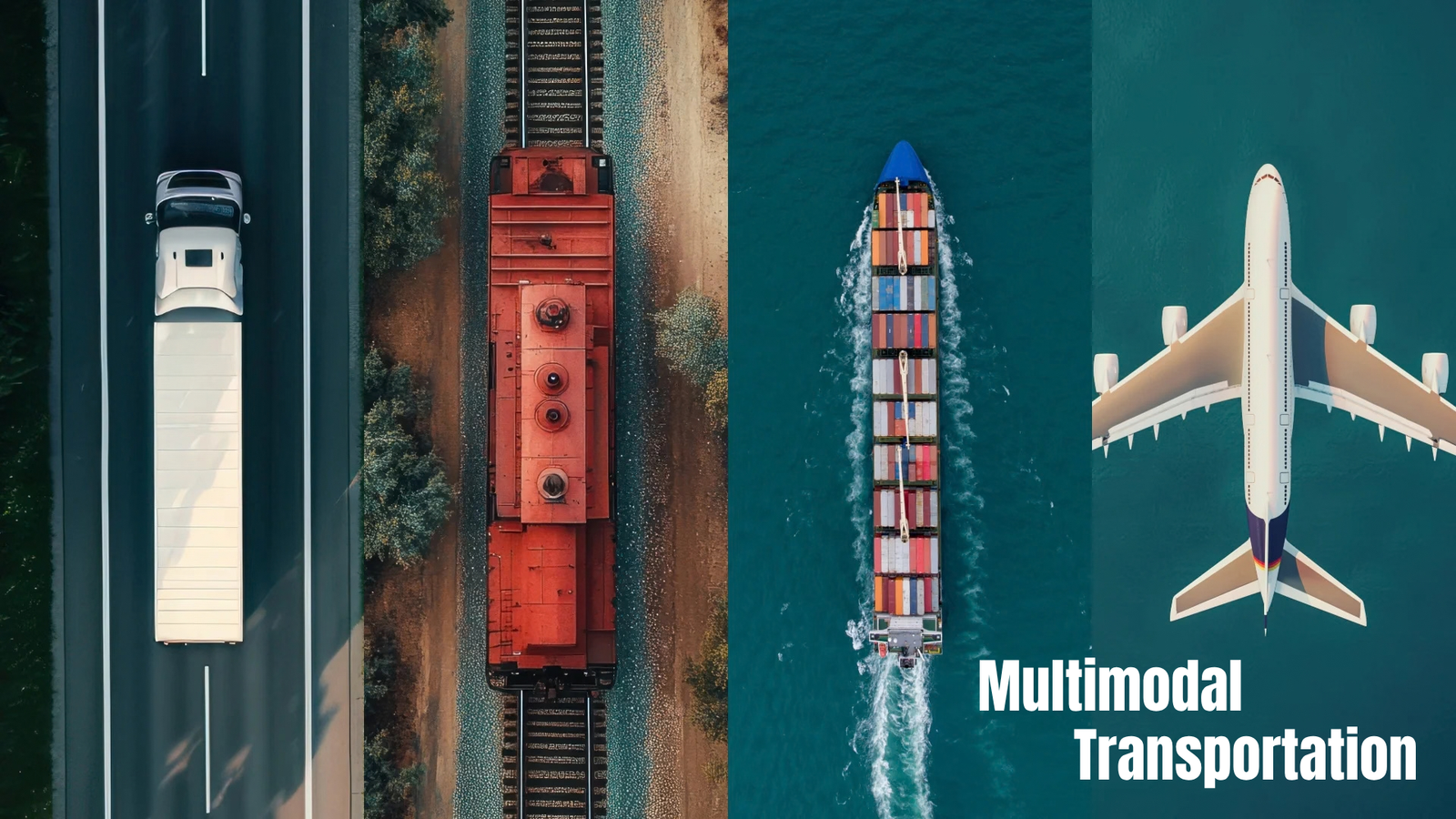
A container may begin its journey on a truck, move by rail to a seaport, travel across the ocean by vessel, and then continue by road to the final destination. When several modes of transport are coordinated as part of one overall transportation solution, the process is commonly referred to as multimodal transportation.
For businesses involved in international trade, multimodal transportation can provide a practical way to connect different parts of the supply chain. Instead of treating road, rail, sea and air transportation as completely separate activities, a multimodal logistics solution brings them together around one planned movement.
This guide explains what multimodal transportation means, how it works, the difference between multimodal and intermodal transportation, its benefits and limitations, the role of customs clearance, documentation, costs, and the situations where businesses may consider using multimodal transport services.
What Is Multimodal Transportation?
Multimodal transportation is the movement of goods using two or more different modes of transportation as part of an integrated transport arrangement.
The modes can include:
- Road transportation
- Rail transportation
- Sea freight
- Air freight
- Inland waterways
A typical international shipment might use road transportation at the origin, rail for inland movement, sea freight for the international leg, and another truck for final delivery.
The important point is not simply that several vehicles or modes are used. The shipment needs to be planned as a connected transportation journey rather than as a series of unrelated movements.
For example, an Indian manufacturer shipping machinery to Europe might move the cargo from its factory by truck to an inland terminal, transport it by rail to a port, ship it by sea to Europe, and then use road transportation for final delivery.
This type of coordinated movement can be particularly useful when a single transportation mode cannot efficiently cover the entire journey.
How Does Multimodal Transportation Work?
Multimodal transportation usually starts with understanding the cargo, origin, destination, delivery requirements, and available transportation infrastructure.
A logistics provider or multimodal transport operator can then determine which combination of transportation modes is suitable.
A typical multimodal shipment may follow these stages:
1. Shipment Planning
The first step is understanding the shipment.
The logistics provider normally considers factors such as cargo type, weight, dimensions, volume, origin, destination, delivery deadline, packaging requirements, budget, and any special handling requirements.
For oversized cargo or project cargo, route restrictions and equipment availability may also become important.
2. Selecting Transportation Modes
The next step is deciding how the shipment should move.
For example:
Factory → Road → Rail → Sea → Road → Final Destination
Another shipment might use:
Supplier → Road → Airport → Air Freight → Road → Customer
The appropriate combination depends on the cargo and the route.
3. Pickup and Origin Transportation
The shipment is collected from the supplier, manufacturer, warehouse, or another agreed location.
Road transportation is often used for first-mile movement because trucks provide flexibility for factory pickups and deliveries to ports, airports, rail terminals, container freight stations, and warehouses.
4. Transfer Between Modes
The shipment may then move to a railway terminal, seaport, airport, inland container depot, or logistics hub.
These transfer points are important because cargo needs to be handled, documented, and transferred from one transportation mode to another.
Poor coordination at this stage can create delays even when each individual transportation service is operating normally.
5. International Transportation
For international shipments, sea freight and air freight are two of the most common long-distance transportation options.
Sea freight is generally associated with larger or less time-sensitive shipments, including FCL and LCL cargo.
Air freight is generally selected when speed is more important or when the cargo has characteristics that make air transportation suitable.
6. Customs Clearance
Customs clearance is an important part of international multimodal transportation.
When goods cross an international border, the required import or export customs procedures must be completed before the shipment can legally proceed through the relevant customs process.
Depending on the shipment and country, customs clearance may involve documents such as:
- Commercial invoice
- Packing list
- Bill of lading
- Air waybill
- Import or export declaration
- HS code information
- Certificates or permits where applicable
- Country-of-origin documentation
- Customs duty and tax information
Incorrect documentation, classification issues, missing information, valuation questions, or regulatory requirements can delay cargo.
This is why customs clearance should be considered during transportation planning rather than treated as something to arrange only after the cargo arrives.
7. Destination Transportation
Once the international transportation and relevant customs procedures are completed, the cargo can continue toward its final destination.
Road or rail transportation may be used depending on the destination and infrastructure.
The shipment can then be delivered to the customer’s warehouse, distribution centre, factory, retail location, project site, or another agreed destination.
What Are the Main Modes Used in Multimodal Transportation?
Multimodal logistics can combine different transportation modes depending on the requirements of the shipment.
Road Transportation
Road freight is flexible and is commonly used for first-mile and last-mile transportation.
It can connect factories, warehouses, ports, airports, rail terminals, distribution centres, and customer locations.
Road transportation is particularly useful where direct access to the shipper or consignee is required.
Rail Transportation
Rail freight can be useful for inland transportation over longer distances.
It can connect production centres and inland logistics hubs with seaports and other major freight locations.
Rail may also be incorporated into multimodal supply chains where businesses want an alternative to moving the entire inland journey by road.
Sea Freight
Sea freight is widely used for international cargo movement.
Businesses can use FCL shipping when they require a full container and LCL consolidation when they have smaller shipments that do not require an entire container.
Sea freight can form the main international leg of a multimodal transportation solution.
Air Freight
Air freight is commonly considered when shipment speed is a major requirement.
It can be useful for urgent commercial cargo, time-sensitive products, high-value shipments, certain electronics, samples, spare parts, and other goods where a shorter transit time has business value.
Inland Waterways
Inland waterways can also form part of a multimodal logistics network where suitable waterways and terminals are available.
The choice depends heavily on geography, infrastructure, cargo requirements, schedules, and connectivity.
Multimodal Transportation vs Intermodal Transportation
Multimodal transportation and intermodal transportation are often used interchangeably in everyday logistics conversations, but they can describe different contractual and operational arrangements.
In a multimodal transportation arrangement, multiple modes are coordinated as part of one integrated transportation service. A multimodal transport operator may take responsibility for arranging the overall movement under a multimodal transport contract.
Intermodal transportation also involves multiple modes, but the shipment may be moved under separate transportation contracts or documents for different legs.
A simple example can make the difference clearer.
Suppose a shipment travels:
Factory → Truck → Rail → Ship → Truck → Customer
The physical movement is similar in both cases.
The distinction can depend on how the transportation is contracted, documented, and managed.
For businesses, the practical question is often less about terminology and more about who is coordinating the shipment, who is responsible for each leg, what documents are issued, and how problems are handled when something goes wrong.
What Are the Benefits of Multimodal Transportation?
Multimodal transportation can provide several advantages when the shipment and route are suitable.
Better Connectivity
One transportation mode rarely provides the most practical solution from origin to destination.
Combining modes allows a shipment to use the strengths of different transportation networks.
A truck can provide flexible pickup, rail can handle inland movement, and sea freight can provide international transportation.
More Flexible Route Planning
A multimodal logistics provider can consider different combinations instead of depending entirely on one mode.
This can be useful when ports, roads, rail networks, airports, or other infrastructure have different strengths and limitations.
Door-to-Door Transportation
One of the major advantages of an integrated logistics solution is the ability to coordinate transportation from the shipper’s location to the consignee’s location.
The customer does not necessarily need to arrange every transportation leg independently.
Potential Cost Efficiency
The cheapest transportation mode is not always the best option for the entire journey.
For example, using road transportation for a long international journey may be impractical, while using air freight for every part of a large shipment may significantly increase transportation costs.
Combining transportation modes can help businesses create a more balanced solution based on cost, speed, cargo characteristics, and route requirements.
Improved Supply Chain Coordination
A coordinated multimodal transportation plan can bring multiple logistics activities under a single operational framework.
This can simplify communication between shippers, carriers, terminals, customs teams, warehouses, and consignees.
Better Use of Infrastructure
Different regions have different transportation strengths.
Multimodal transportation allows businesses to connect road networks with railways, ports, airports, inland terminals, and logistics parks.
India’s logistics development has increasingly focused on connecting these different infrastructure networks. National initiatives such as PM Gati Shakti and the National Logistics Policy place significant emphasis on integrated and multimodal logistics planning.
Support for International Trade
Importers and exporters often need several transportation services before cargo reaches its destination.
Multimodal transportation can connect domestic pickup, port or airport handling, international freight, customs clearance, and final delivery into one broader logistics plan.
What Are the Challenges of Multimodal Transportation?
Multimodal transportation also has challenges.
Using multiple modes creates additional transfer points, and every transfer introduces another opportunity for delays or handling problems.
Some common challenges include:
- Coordination between multiple carriers
- Different transportation schedules
- Terminal congestion
- Documentation errors
- Customs delays
- Cargo handling during transfers
- Equipment availability
- Unexpected route disruptions
- Communication gaps between service providers
- Additional handling requirements
- Changes in transportation costs
This is why multimodal transportation requires careful planning and active shipment management.
The success of a multimodal shipment depends not only on selecting the modes but also on coordinating the transitions between them.
What Documents Are Needed for Multimodal Transportation?
Documentation depends on the cargo, route, countries involved, transportation modes, and applicable regulations.
Common documents can include:
- Commercial invoice
- Packing list
- Purchase order
- Bill of lading
- Air waybill
- Multimodal transport document
- Import or export declaration
- Certificate of origin
- Insurance documents
- HS code details
- Permits or licenses where required
- Customs documentation
For international shipments, document accuracy is particularly important.
The description of goods, quantity, value, origin, classification, consignee information, and other details should be consistent across relevant documents.
A documentation mismatch can create questions at customs or during cargo handling.
How Does Customs Clearance Fit Into Multimodal Transportation?
Customs clearance is one of the most important parts of international logistics.
It is the process through which goods are declared to the relevant customs authority and the applicable procedures are completed for import or export.
Customs clearance can involve classification, valuation, documentation, duties and taxes, examination, regulatory compliance, and release procedures.
In a multimodal shipment, customs clearance may occur at an international border, port, airport, inland customs facility, or another authorised location depending on the shipment structure.
This means customs planning should happen before the shipment starts moving.
For example, if an importer waits until cargo reaches a port to discover that a required document or permit is missing, the shipment may face additional delays.
A freight forwarder or customs clearance specialist can help coordinate the documentation and customs requirements as part of the broader logistics process.
How Much Does Multimodal Transportation Cost?
There is no single fixed price for multimodal transportation.
The total cost depends on several factors, including:
- Origin and destination
- Cargo weight
- Cargo volume
- Cargo dimensions
- Transportation modes
- Fuel costs
- Freight rates
- Container type
- Port charges
- Terminal handling
- Customs duties and taxes
- Documentation charges
- Warehousing
- Insurance
- Local transportation
- Special handling requirements
- Delivery distance
- Seasonal demand
For containerized cargo, businesses may compare FCL and LCL options depending on shipment volume.
For urgent shipments, air freight may be considered against sea freight based on the value of time.
For large or heavy cargo, road, rail, sea, break bulk, or project logistics solutions may need to be evaluated together.
The right comparison is therefore not simply the freight rate of one transportation mode. Businesses should consider the total landed logistics cost and the time required to deliver the cargo.
When Should a Business Use Multimodal Transportation?
Multimodal transportation can be considered when a shipment needs more than one transportation mode to reach its destination efficiently.
It can be particularly relevant for:
- International import shipments
- International export shipments
- Manufacturing supply chains
- Retail distribution
- E-commerce logistics
- Automotive logistics
- Industrial equipment
- Machinery shipments
- Project cargo
- Heavy cargo
- Time-sensitive shipments
- Long-distance domestic distribution
- Port-to-inland transportation
- Factory-to-door international delivery
For example, an Indian manufacturer located far from a major seaport may use road transportation to reach an inland terminal, rail transportation for part of the inland journey, sea freight for the international leg, and road transportation again at the destination.
Multimodal Transportation in India
India has a large and diverse transportation network that includes highways, railways, ports, airports, inland waterways, logistics parks, container terminals, and warehouses.
The country’s logistics policies and infrastructure programmes increasingly emphasize connecting these different networks.
PM Gati Shakti focuses on integrated infrastructure planning and multimodal connectivity, while the National Logistics Policy aims to improve efficiency, technology adoption, coordination, and logistics performance. Government programmes have also supported the development of Multi-Modal Logistics Parks designed to connect different transportation modes and provide logistics services.
This broader development matters to businesses because efficient connections between production centres, logistics hubs, ports, airports, rail terminals, and markets can influence transportation planning.
For Indian importers and exporters, multimodal transportation can therefore be relevant to international shipping routes connecting locations such as Delhi NCR, Mumbai, Chennai, Bengaluru, Hyderabad, Ahmedabad, Kolkata, Mundra, Nhava Sheva/JNPT, and other industrial and logistics centres.
The exact route, however, should always be evaluated according to the shipment rather than assuming one standard combination works for every business.
Multimodal Transportation for Importers and Exporters
For an importer or exporter, the biggest advantage of using an integrated logistics provider can be coordination.
Instead of separately arranging:
Truck → Warehouse → Rail → Port → Sea Freight → Destination Port → Customs Clearance → Truck
the business can work with a logistics partner that coordinates the relevant stages.
This can make shipment planning easier, particularly for businesses that regularly move cargo internationally.
However, companies should understand exactly what is included in the quoted service.
Before confirming a multimodal shipment, ask about:
- Pickup charges
- Freight charges
- Documentation
- Customs clearance
- Port and terminal charges
- Loading and unloading
- Warehousing
- Insurance
- Delivery charges
- Duties and taxes
- Transit time
- Shipment tracking
- Potential additional charges
A detailed quotation makes it easier to understand the actual logistics cost.
How to Choose a Multimodal Transport Service Provider
Choosing a multimodal transportation provider involves more than comparing freight rates.
Look at the provider’s ability to coordinate different transportation modes and manage international shipments.
Important considerations include:
Experience
Check whether the logistics provider regularly handles shipments similar to yours.
Network
A strong transportation network can be important for connecting origin locations, ports, airports, inland terminals, and final destinations.
Customs Support
For international shipments, customs clearance experience can be extremely valuable.
Documentation
Ask how shipping and customs documents are prepared, checked, and managed.
Shipment Visibility
Tracking and regular communication can make it easier to monitor cargo during different transportation stages.
Handling Capability
If the cargo is fragile, oversized, heavy, high-value, or otherwise specialised, ask about the provider’s experience with that type of shipment.
Transparent Pricing
The quotation should clearly explain what is included and identify potential additional charges.
Multimodal Transportation vs Single-Mode Transportation
Single-mode transportation uses one primary transportation method for the shipment.
For example:
- Road only
- Rail only
- Sea only
- Air only
Multimodal transportation combines two or more modes.
Neither approach is automatically suitable for every shipment.
A short domestic shipment may be handled efficiently by road alone.
A large international shipment may require road plus sea transportation.
A time-sensitive international shipment might use road plus air freight.
A long inland journey may benefit from a combination of road and rail.
The best transportation structure depends on cargo requirements, route, timing, budget, infrastructure, and customs considerations.
Common Mistakes Businesses Make With Multimodal Shipping
One of the most common mistakes is focusing only on the international freight rate.
The actual logistics cost can include many other components.
Another common mistake is failing to plan customs clearance early.
Businesses can also underestimate the importance of accurate cargo dimensions and weight. Incorrect information can affect equipment planning, freight charges, handling, and documentation.
Other mistakes include:
- Choosing transportation modes without considering the complete route
- Ignoring first-mile and last-mile costs
- Not checking documentation requirements
- Underestimating transit buffers
- Failing to consider cargo handling requirements
- Comparing only freight rates instead of total logistics cost
- Not asking about additional charges
- Poor communication between different service providers
A good multimodal transportation plan considers the entire shipment from pickup to final delivery.
Multimodal Transportation Checklist
Before booking a multimodal shipment, businesses can review the following checklist:
- Confirm the exact origin and destination.
- Measure cargo dimensions and weight accurately.
- Determine whether the cargo is FCL, LCL, air cargo, project cargo, or another category.
- Identify suitable transportation modes.
- Check required import or export documentation.
- Confirm HS code and customs requirements where applicable.
- Understand customs clearance responsibilities.
- Compare total logistics costs.
- Confirm expected transit time.
- Check insurance requirements.
- Ask about tracking and shipment visibility.
- Confirm pickup and final delivery arrangements.
- Understand port, terminal, handling, and documentation charges.
- Allow reasonable time for customs and operational delays.
Frequently Asked Questions About Multimodal Transportation
What is multimodal transportation?
Multimodal transportation is the movement of goods using two or more transportation modes as part of an integrated transportation arrangement.
What are the main modes of multimodal transport?
The main modes include road, rail, sea, air, and inland waterways. A shipment can use any combination that suits its route and requirements.
What is the difference between multimodal and intermodal transportation?
Both involve multiple modes, but they can differ in their contractual and documentation structure. Multimodal transport generally involves an integrated transportation arrangement, while intermodal movements may involve separate contracts or documents for individual legs.
Is customs clearance included in multimodal transportation?
It can be. Some logistics providers offer customs clearance as part of an integrated multimodal logistics service, while others treat customs clearance as a separate service. Always confirm what is included in the quotation.
Is multimodal transportation cheaper than air freight?
It depends on the shipment. A multimodal solution may combine different transportation modes to balance cost and transit time, but the total price depends on the cargo, route, services, and market conditions.
Can multimodal transportation include sea freight?
Yes. Sea freight is frequently used as one part of international multimodal transportation, often combined with road or rail transportation.
Can LCL shipments use multimodal transportation?
Yes. LCL cargo can be incorporated into a multimodal logistics plan when the shipment uses multiple transportation modes from origin to destination.
Can FCL shipments use multimodal transportation?
Yes. An FCL container can move by truck, rail, and sea as part of a multimodal transportation arrangement.
What documents are required for multimodal shipping?
Documents vary according to the shipment and route but may include commercial invoices, packing lists, transport documents, customs declarations, certificates of origin, permits, and other regulatory documentation.
How long does multimodal transportation take?
There is no universal transit time. It depends on the origin, destination, transportation modes, cargo, schedules, customs clearance, terminal operations, and delivery requirements.
Is multimodal transportation suitable for international trade?
Yes. It can be particularly useful when international shipments require several transportation modes to move cargo from the shipper’s location to the final destination.
How do I choose the right multimodal logistics solution?
Start with the cargo characteristics, origin, destination, delivery deadline, budget, customs requirements, and available infrastructure. A logistics provider can then evaluate different transportation combinations.
What should you do?
Multimodal transportation is more than simply moving cargo using different vehicles.
It is about connecting different transportation modes into a coordinated logistics journey.
For one shipment, that might mean truck plus sea freight. For another, it could be road plus rail plus sea plus road. A time-sensitive shipment may combine road and air freight, while a large industrial project may require a more complex combination of transportation, warehousing, customs clearance, special handling, and final delivery.
The value of multimodal logistics comes from coordinating these individual pieces around the requirements of the shipment.
For importers and exporters, the process also extends beyond transportation. Documentation, customs clearance, duties and taxes, cargo handling, tracking, warehousing, and final delivery all need to be considered when planning the shipment.
As supply chains become more connected and businesses trade across increasingly complex markets, the ability to combine transportation modes efficiently can become an important part of international logistics planning.
For businesses looking for multimodal transportation services, the right approach is to evaluate the complete journey rather than focusing on one individual freight rate. A well-planned solution should balance transportation cost, transit time, cargo requirements, customs compliance, reliability, and final delivery requirements.
For international shipments, working with an experienced freight forwarding and logistics partner can help bring these different stages together and create a more organized path from origin to destination.