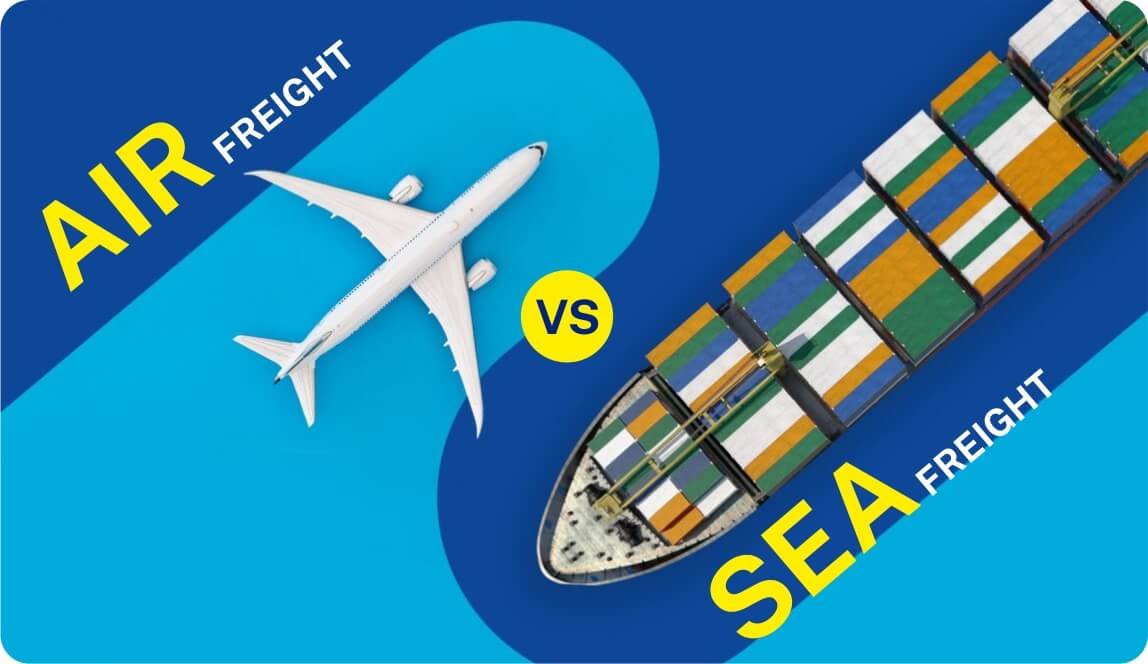
When a business needs to move goods internationally, one of the first decisions it has to make is surprisingly simple: Should the shipment go by air or by sea?
The answer is not always about choosing the cheapest freight rate or the fastest transportation method. A shipment of smartphones, pharmaceuticals or urgent spare parts has very different requirements from a container of furniture, machinery, textiles or raw materials.
This is where air freight and sea freight serve different purposes.
Air freight is built around speed, connectivity and time-sensitive cargo. Sea freight, on the other hand, is the backbone of international cargo transportation, particularly for large volumes and goods where transit time is less critical.
The scale of the difference is significant. According to the International Air Transport Association (IATA), air cargo represented just 0.8% of global trade by weight in its 2025 sample but nearly 29.5% by value, while sea transport represented 87.1% by weight and 44.4% by value. The figures illustrate an important point: air cargo is disproportionately used for valuable and time-sensitive goods, while ocean transport handles enormous physical volumes.
So, what exactly is the difference between air freight and sea freight, and how should an importer or exporter decide between them?
Let’s break it down.
Air Freight vs Sea Freight: The Basic Difference
The simplest explanation is this:
Air freight transports cargo by aircraft, while sea freight transports cargo by vessel.
But the practical difference goes much deeper.
Air freight generally offers much shorter transit times and is particularly useful for high-value, urgent, perishable or time-sensitive goods. Sea freight is generally better suited to large-volume shipments, heavy cargo and businesses that can plan around longer transportation schedules.
In other words, the choice is often a balance between:
Speed + urgency + cargo value
and
Volume + cost efficiency + planning flexibility.
Neither mode is universally suitable for every shipment.
What Is Air Freight?
Air freight is the transportation of commercial cargo by aircraft between airports. It can involve dedicated cargo aircraft, passenger aircraft carrying cargo in their belly holds, or a combination of services arranged by a freight forwarder.
Air freight is commonly used for:
- Electronics
- Pharmaceuticals
- Medical supplies
- High-value products
- Perishable goods
- Fashion products
- Urgent spare parts
- Samples and prototypes
- Time-sensitive documents and commercial shipments
- E-commerce products
- Emergency replacement equipment
The reason companies choose air transportation is often straightforward: time has a financial value.
If a factory is waiting for a critical component, a retailer needs products before a seasonal sales period, or a pharmaceutical shipment requires controlled and timely transportation, saving several days can be more valuable than saving money on the freight rate.
IATA reports that airlines transport more than 62 million tonnes of cargo annually, representing more than one-third of global trade by value while accounting for less than 1% of trade by volume.
That is a useful way to understand the role of air freight: it carries a relatively small physical share of world trade but a very substantial share of its economic value.
What Is Sea Freight?
Sea freight, also called ocean freight, is the transportation of cargo by ship between ports.
It is one of the most important components of international trade because vessels can transport enormous quantities of cargo in containers and specialized equipment.
Sea freight is commonly used for:
- Machinery
- Furniture
- Textiles
- Automotive components
- Industrial equipment
- Consumer goods
- Raw materials
- Construction materials
- Chemicals
- Agricultural products
- Large commercial shipments
Ocean shipping also supports several different service models, including:
- FCL — Full Container Load
- LCL — Less than Container Load
- Break bulk
- Project cargo
- Specialized container shipping
For businesses importing or exporting substantial quantities, sea freight can provide the capacity needed to move cargo internationally without the cost structure associated with air transportation.
Air Freight vs Sea Freight: Key Differences
Here is the comparison at a glance:
| Factor | Air Freight | Sea Freight |
| Transportation mode | Aircraft | Cargo vessel |
| Transit time | Generally much faster | Generally slower |
| Typical cargo | High-value, urgent and time-sensitive goods | High-volume, heavy and less time-sensitive goods |
| Shipment capacity | More limited | Very high |
| Freight cost | Generally higher | Generally lower per unit for large-volume cargo |
| Best for | Urgent and valuable shipments | Large and planned shipments |
| Scheduling | Frequent flight networks on many routes | Sailing schedules |
| Environmental intensity | Generally higher per tonne-km | Generally lower per tonne-km |
| Handling | Airport-based cargo handling | Port, terminal and container handling |
| Common services | Airport-to-airport, door-to-door air freight | FCL, LCL, port-to-port and door-to-door |
|---|
Actual cost and transit time depend on the origin, destination, carrier, route, cargo characteristics, customs requirements and inland transportation arrangements.
Which Is Faster: Air Freight or Sea Freight?
Air freight is generally much faster than sea freight.
That is its most obvious advantage.
An international air shipment may reach its destination within a few days, depending on the route and service. Sea freight can take considerably longer because the shipment must move through port operations, sailing schedules, transshipment points and destination procedures.
However, businesses should be careful when comparing a simple flight time with a complete sea freight transit time.
International freight involves more than the time an aircraft or ship spends moving.
A complete shipment may include:
- Supplier pickup
- Export documentation
- Cargo handling
- Customs clearance
- Airport or port processing
- Main transportation
- Destination handling
- Import customs clearance
- Inland transportation
- Final delivery
Therefore, when comparing air and sea freight, ask your logistics provider for the end-to-end transit time, rather than looking only at the main transportation leg.
Which Is Cheaper: Air Freight or Sea Freight?
For large and heavy shipments, sea freight is generally more cost-efficient than air freight.
Air transportation requires aircraft capacity, aviation fuel and specialized airport handling. Sea transportation can distribute the cost of moving very large quantities of cargo across the enormous capacity of a container vessel.
But saying “sea freight is always cheaper” would be misleading.
The right comparison depends on:
- Cargo weight
- Cargo volume
- Chargeable weight
- Origin
- Destination
- Delivery requirements
- Container type
- Fuel and market conditions
- Port or airport charges
- Customs requirements
- Inland transportation
- Required delivery date
There is another consideration that businesses sometimes overlook: the cost of waiting.
Suppose a company can save money by choosing sea freight but has to wait several additional weeks for inventory. If that delay causes production downtime, missed sales or an empty warehouse, the cheaper freight option may not produce the lowest overall supply-chain cost.
This is why experienced freight forwarders look beyond the transportation rate.
Air Freight or Sea Freight: Which Is Better for Your Business?
Instead of asking which transportation mode is “better,” ask:
What does this particular shipment need?
Choose Air Freight When Speed Matters
Air freight can make sense when:
- The shipment is urgent.
- The cargo is high in value relative to its weight.
- Inventory shortages could disrupt operations.
- The goods are perishable.
- You are shipping pharmaceuticals or medical products.
- You need to meet a strict launch or delivery date.
- A production line is waiting for replacement components.
- The shipment is relatively small.
- The cost of delay is greater than the additional freight cost.
IATA notes that products frequently transported by air include pharmaceuticals, high-value goods, perishables and other commodities where speed and value are important factors.
Choose Sea Freight When Volume Matters
Sea freight can be appropriate when:
- You are shipping large quantities.
- Cargo is heavy or bulky.
- The delivery schedule allows longer transit.
- You want to control transportation costs for high-volume shipments.
- You regularly import or export containerized cargo.
- Your products are not particularly time-sensitive.
- You need FCL or LCL services.
For example, a company importing 20 tonnes of furniture is likely to approach transportation very differently from a technology company sending a small shipment of high-value electronic components.
Air Freight vs Sea Freight for International Shipping
International transportation does not end when the aircraft lands or the vessel reaches the port.
A reliable freight solution also requires coordination of documentation, customs, cargo handling and inland transportation.
For an air shipment, the logistics chain may look like:
Supplier → Pickup → Export Customs → Airport → Air Freight → Destination Airport → Import Customs → Delivery
For sea freight:
Supplier → Pickup → Export Customs → Port/CFS → Ocean Freight → Destination Port → Import Customs → Inland Delivery
This distinction is important because customs clearance and inland transportation can influence the total delivery time and final logistics cost.
A freight forwarder can coordinate these different stages so that the shipment is treated as one connected supply-chain movement rather than several disconnected activities.
What About LCL and FCL Sea Freight?
Businesses often assume that choosing sea freight automatically means booking an entire container.
That is not necessarily the case.
LCL — Less than Container Load
With LCL shipping, cargo from multiple shippers is consolidated into one container.
LCL is useful when a business does not have enough cargo to justify an entire container or wants to move smaller quantities without waiting until enough goods accumulate for an FCL shipment.
This makes LCL consolidation services particularly relevant for small and medium-sized importers, exporters and businesses with irregular shipment volumes.
FCL — Full Container Load
With FCL shipping, the container is dedicated to one shipper’s cargo.
FCL is generally used for larger shipments or when dedicated container space makes operational and commercial sense.
A business may use a 20-foot or 40-foot container depending on cargo volume, weight, dimensions and requirements.
The choice between LCL and FCL is therefore another important decision within sea freight.
Air Freight vs Sea Freight: What About Carbon Emissions?
Environmental impact is increasingly part of freight procurement decisions.
In general, air freight has a much higher carbon intensity per tonne-kilometre than sea freight.
An IMO comparison based on earlier transport-efficiency data estimated average CO₂ intensity at approximately 570 grams per tonne-kilometre for air freight versus 11 grams for sea transport. These figures are historical estimates and should not be treated as a universal current value for every route or shipment, but they illustrate the substantial difference in transport-mode efficiency.
The actual carbon footprint of a shipment varies according to aircraft or vessel type, distance, load factor, routing, fuel and methodology.
IATA now provides shipment-level cargo emissions calculations using airline-specific operational data, including actual fuel consumption and load factors.
This is important because businesses should avoid using one generic emissions number for every air shipment.
Does Air Freight Always Make Sense for High-Value Cargo?
Not necessarily.
Cargo value is an important consideration, but it should not be the only one.
A high-value product that is not urgent and is being shipped in large quantities may still be appropriate for ocean freight.
Conversely, a relatively inexpensive component could justify air freight if its absence would stop an entire production line.
This is where inventory carrying cost, stock-out risk, product value, urgency and customer commitments become part of the transportation decision.
The best logistics decision is therefore often the one that minimizes the total business impact—not simply the freight invoice.
Air Freight vs Sea Freight for Indian Importers and Exporters
For businesses in India, the choice between air and sea freight can be particularly important because Indian companies operate across diverse international trade lanes.
A manufacturer in India exporting machinery to Europe may have very different requirements from an e-commerce business shipping small, high-value products to the Middle East.
Similarly, an importer sourcing raw materials from China may prioritize predictable ocean transportation and container capacity, while a business importing urgent electronic components may prioritize air cargo.
A freight forwarder can assess the complete shipment based on:
- Pickup location
- Airport or seaport
- Destination
- Cargo type
- Weight
- Dimensions
- CBM
- Required delivery date
- Customs requirements
- Packaging
- Incoterms
- Final delivery location
This information makes it possible to compare air freight and sea freight on a shipment-specific basis.
A Simple Example: Air or Sea?
Imagine an Indian manufacturer needs to send two different shipments.
Shipment A: 500 kg of urgent machine components required to restart a production line.
Shipment B: 20 tonnes of packaged furniture being shipped for planned inventory replenishment.
Shipment A may justify air freight because the cost of production downtime could be greater than the additional transportation cost.
Shipment B may be better suited to sea freight because of its weight and volume and because the delivery can be planned around an ocean schedule.
The products are both being shipped internationally, but the logistics priorities are completely different.
That is the real difference between choosing air and sea transportation.
Air Freight and Sea Freight Are Often Part of the Same Supply Chain
There is no rule saying that a company must use only one mode of transportation.
Many international supply chains use multimodal transportation.
For example, a shipment could move:
Factory → Truck → Airport → Aircraft → Destination Airport → Truck → Customer
Another shipment could move:
Factory → Truck → Port → Vessel → Destination Port → Truck → Customer
Businesses can also combine modes depending on inventory requirements, destination, urgency and cargo characteristics.
This is especially useful for companies that operate multiple product lines with different delivery requirements.
Frequently Asked Questions
What is the main difference between air freight and sea freight?
The main difference is the transportation mode and its resulting trade-offs. Air freight uses aircraft and generally prioritizes speed, while sea freight uses vessels and generally provides much greater cargo capacity and cost efficiency for large shipments.
Is air freight faster than sea freight?
Yes. Air freight is generally significantly faster, although actual delivery time depends on the route, flight schedule, customs clearance and inland transportation.
Is sea freight cheaper than air freight?
For many large and heavy shipments, sea freight is generally more cost-efficient than air freight. However, the final cost depends on cargo volume, weight, route, handling, customs and delivery requirements.
Which is better for heavy cargo?
Sea freight is generally better suited to large, heavy and bulky shipments, particularly when the cargo is not highly time-sensitive.
Which is better for urgent shipments?
Air freight is generally the more suitable option when delivery speed is critical.
Is air freight more environmentally intensive than sea freight?
Generally, yes, when comparing transport emissions per tonne-kilometre. However, actual shipment emissions depend on the route, equipment, load factor and calculation methodology.
Can small businesses use sea freight?
Yes. Small businesses can use LCL consolidation services to ship cargo without booking an entire container.
Can a company use both air and sea freight?
Absolutely. Businesses often use different transportation modes for different products, markets and delivery requirements.
The Bottom Line: Air Freight or Sea Freight?
The difference between air freight and sea freight is ultimately about more than air versus ocean.
It is about matching the transportation method to the commercial requirements of the shipment.
Choose air freight when speed, urgency, high cargo value or time-sensitive delivery is the priority.
Choose sea freight when volume, weight, capacity and transportation cost are more important and the business can accommodate a longer transit period.
For some businesses, the answer will be LCL. For others, it will be FCL. Some shipments may move by air, while others move by sea—and a multimodal solution may make sense when the supply chain demands greater flexibility.
At Divine Sea Air Logistics, air freight and sea freight can be evaluated as part of a broader international logistics plan, including cargo handling, customs clearance, inland transportation, LCL consolidation, FCL shipping and multimodal transportation.
If you are unsure which option fits your shipment, the most useful starting point is not simply asking for an air or ocean freight rate.
Provide your origin, destination, cargo type, weight, dimensions/CBM and required delivery date. From there, a freight professional can compare the available transportation options and help you understand the difference in cost, transit time and overall logistics requirements.