LCL and FCL shipping are two of the most widely used methods of transporting commercial cargo by sea. But which option is right for your shipment?
When businesses import or export goods internationally, choosing the right ocean freight solution can directly affect shipping costs, transit times, cargo handling, inventory planning, and overall supply chain efficiency. For smaller shipments, LCL (Less than Container Load) can provide a flexible way to move cargo without paying for an entire container. For larger or high-volume shipments, FCL (Full Container Load) provides dedicated container space for one shipper.
Understanding the difference between LCL and FCL shipping helps importers, exporters, manufacturers, wholesalers, retailers, e-commerce businesses, and project cargo companies select a transportation solution based on their cargo volume, destination, schedule, budget, and handling requirements.
At Divine Seair Logistics, we provide LCL consolidation and FCL shipping solutions designed to support businesses moving cargo from India to international markets and from global origins into India.
What Is LCL Shipping?
LCL stands for Less than Container Load. It is an ocean freight service in which cargo from multiple shippers is consolidated into the same shipping container.
Instead of booking an entire container for a relatively small shipment, a business pays for the space its cargo occupies. LCL freight is commonly measured according to cargo volume in cubic metres (CBM), although weight and other shipment characteristics can also affect the applicable charges.
For example, imagine a company needs to ship several pallets of products from India to Europe but does not have enough cargo to justify booking an entire 20-foot or 40-foot container. With LCL consolidation, its shipment can be combined with cargo belonging to other businesses.
At the destination, the consolidated container is deconsolidated and the individual shipments are separated for onward delivery.
How Does LCL Consolidation Work?
A typical LCL shipment follows several stages:
- Cargo pickup or delivery to the origin facility
- Cargo measurement, documentation and verification
- Transportation to a Container Freight Station (CFS)
- Consolidation with other LCL shipments
- Container loading and export processing
- Ocean transportation
- Arrival at the destination port
- Container deconsolidation
- Import customs clearance
- Final delivery to the consignee
This consolidation process allows businesses to move smaller cargo quantities internationally without waiting until they have enough goods to fill an entire container.
What Is FCL Shipping?
FCL stands for Full Container Load. In FCL shipping, a container is booked exclusively for cargo belonging to one shipper.
The container does not necessarily have to be physically filled to 100% capacity. The key difference is that the container space is dedicated to one shipment rather than shared with cargo from multiple shippers.
FCL is commonly used by manufacturers, exporters, importers, distributors and other businesses moving larger quantities of cargo.
For example, a manufacturer exporting machinery, furniture, consumer products or industrial components may book a dedicated container from India to an overseas destination. The cargo can be loaded at the origin, the container sealed, and then transported through the international supply chain.
LCL vs FCL: What Is the Difference?
The basic distinction is straightforward:
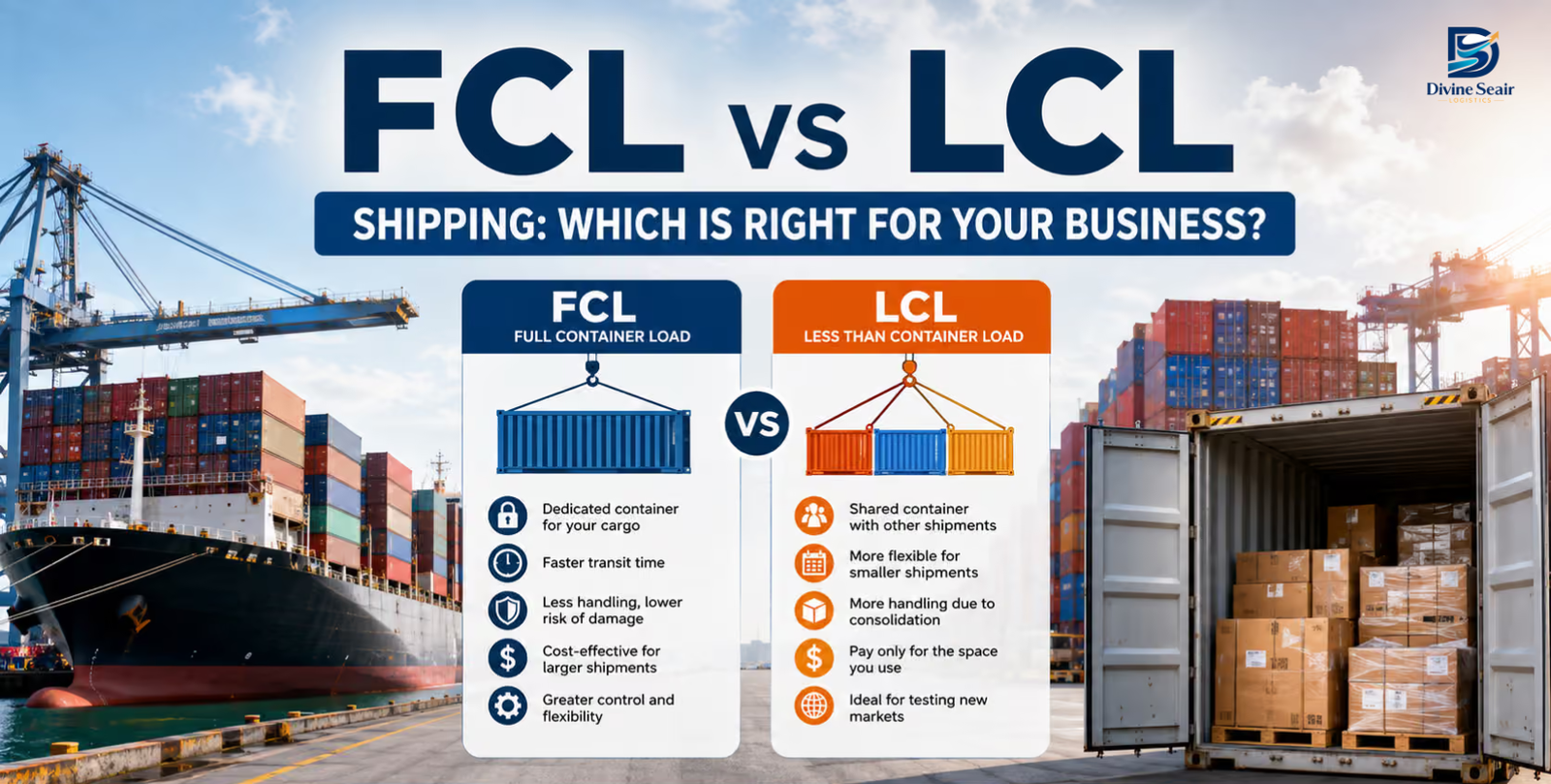
LCL shipping shares container space, while FCL shipping provides dedicated container space to one shipper.
However, the decision involves more than container space.
| Factor | LCL Shipping | FCL Shipping |
|---|
| Full form | Less than Container Load | Full Container Load |
| Container space | Shared | Dedicated |
| Typical use | Smaller shipments | Larger shipments |
| Pricing basis | Generally based on cargo volume/weight and applicable charges | Generally quoted per container |
| Consolidation | Required | Generally not required with other shippers |
| Deconsolidation | Required at destination | Not required between different customers |
| Shipment flexibility | Useful for smaller or irregular volumes | Useful for regular or high-volume cargo |
| Cargo handling | More handling points may be involved | Fewer consolidation-related handling points |
| Inventory strategy | Useful for smaller, frequent shipments | Useful for larger planned shipments |
Actual transit times, rates, handling procedures and charges vary by origin, destination, carrier, routing, cargo characteristics and service requirements. DHL and Maersk both identify cargo volume, routing and service conditions as important considerations when selecting between LCL and FCL.
When Should You Choose LCL Shipping?
LCL is generally suitable when your shipment does not require an entire container.
Businesses may consider LCL ocean freight when:
- The shipment volume is relatively small.
- Cargo is shipped periodically rather than in large batches.
- Inventory needs to be replenished without waiting to fill a container.
- The business wants to avoid paying for unused container capacity.
- Multiple smaller shipments need to move through international trade lanes.
- The shipment is not suitable for parcel or courier transportation but does not justify FCL.
Maersk notes that LCL can be particularly appropriate for smaller or irregular shipment volumes, while DHL describes LCL as a solution for shipments that do not require an entire container.
Advantages of LCL Shipping
1. Pay for the space you use
One of the major advantages of LCL is that you do not need to reserve an entire container for a relatively small shipment. Costs are generally calculated using shipment volume and weight, together with applicable origin, destination and handling charges.
2. Greater flexibility for smaller shipments
Businesses can ship smaller quantities instead of accumulating cargo for a full container.
3. Supports inventory management
LCL can help companies replenish stock in smaller quantities, potentially reducing the need to hold large amounts of inventory simply to make up a container.
4. Useful for international expansion
Businesses entering new markets can test demand with smaller shipments before moving to larger container volumes.
5. Suitable for irregular shipment volumes
If your cargo volumes fluctuate significantly from month to month, LCL can provide an alternative to booking an entire container when volumes are low.
When Should You Choose FCL Shipping?
FCL shipping becomes relevant when a business has enough cargo to make dedicated container space commercially and operationally appropriate.
You may consider FCL ocean freight when:
- You regularly ship large cargo volumes.
- Your cargo can efficiently use a 20-foot, 40-foot or other suitable container.
- Cargo requires dedicated container space.
- You want to minimize consolidation and deconsolidation handling.
- Your shipment schedule requires a dedicated container booking.
- The cargo is sensitive to additional handling.
- You need to move large quantities from one origin to one destination.
FCL can also be useful even when a container is not completely full if the dedicated-container arrangement provides operational advantages for the shipment. Maersk specifically notes that FCL means the container is reserved for one shipper and does not have to be filled completely.
Advantages of FCL Shipping
1. Dedicated container space
Your cargo occupies the container exclusively, avoiding the need to share container space with unrelated shipments.
2. Fewer consolidation-related handling stages
Because FCL does not require the same type of multi-shipper consolidation and destination deconsolidation process as LCL, it can simplify cargo movement.
3. Suitable for high-volume cargo
Manufacturers and large exporters can move substantial quantities in a single shipment.
4. Better control over container loading
Businesses can plan container loading around their own cargo, packaging and operational requirements.
5. Suitable for planned supply chains
For companies with predictable shipping volumes, scheduled FCL movements can form an important part of an international logistics strategy.
LCL vs FCL: Which Is More Cost-Effective?
There is no universal answer to whether LCL or FCL is cheaper.
For a smaller shipment, booking an entire container can mean paying for capacity that is not needed. LCL can therefore be commercially appropriate because the shipment uses only part of the container.
As shipment volume increases, however, the total LCL charges can approach or exceed the economics of booking a dedicated FCL container. DHL notes that LCL pricing involves multiple cost components and is generally influenced by cargo weight and measurement/volume, while FCL is typically priced at the container level.
A freight forwarder can compare the LCL cost per CBM with the applicable FCL container rate and associated origin, destination, documentation, customs and inland transportation charges.
This is important because comparing only the ocean freight rate can produce an incomplete picture.
LCL and FCL Shipping Costs: What Affects the Final Price?
The final freight cost can depend on several factors, including:
- Origin and destination
- Cargo volume
- Cargo weight
- Number of packages or pallets
- Container type and size
- Port and terminal charges
- CFS charges for LCL cargo
- Documentation requirements
- Customs clearance
- Inland transportation
- Fuel and carrier-related surcharges
- Seasonal market conditions
- Cargo characteristics
- Special handling requirements
- Delivery location
- Incoterms and responsibilities of buyer and seller
DHL similarly identifies origin, destination, container type, seasonal demand and additional services among factors that can influence container shipping rates.
For this reason, businesses should request a shipment-specific quotation rather than relying solely on a general online freight rate.
LCL vs FCL Transit Time
Transit time depends on the trade lane, carrier schedule, port congestion, customs procedures, inland transportation and other operational factors.
LCL can involve additional consolidation and deconsolidation steps. As a result, LCL transit can sometimes take longer than an equivalent FCL service. DHL specifically notes that LCL transit times are typically somewhat longer because of consolidation and deconsolidation activities.
However, actual delivery time should always be confirmed for the specific origin-destination route.
For urgent cargo, businesses should compare the available LCL and FCL sailing schedules, cut-off times, handling requirements and final-mile delivery arrangements before booking.
LCL and FCL Shipping From India
India is a major manufacturing, sourcing and trading market, making reliable ocean freight services important for importers and exporters.
Businesses shipping from India may use LCL consolidation for smaller cargo volumes and FCL shipping for larger shipments.
Depending on the origin, cargo may move through major Indian ports and gateways before continuing to destinations across Asia, Europe, the Middle East, Africa, North America and other international markets.
A complete ocean freight solution can include:
- Export documentation
- Pickup from supplier or warehouse
- CFS coordination
- LCL consolidation
- FCL container booking
- Port handling
- Export customs clearance
- Ocean transportation
- Import documentation
- Destination customs clearance
- Inland transportation
- Final delivery
DHL’s India container shipping service, for example, describes container solutions connecting Indian origins with international destinations and combining ocean transportation with customs and other logistics services.
How to Choose Between LCL and FCL
Before selecting a service, businesses should consider five key questions:
1. How much cargo are you shipping?
Cargo volume is one of the most important starting points. Smaller shipments may fit naturally into LCL, while larger volumes may justify FCL.
2. How frequently do you ship?
If shipments are small but frequent, LCL can help avoid waiting until enough goods accumulate for a full container.
3. How important is the delivery schedule?
Compare available sailing schedules, consolidation cut-offs, transit times and destination handling requirements.
4. Does your cargo require dedicated container space?
Certain cargo may benefit from dedicated container arrangements depending on its characteristics, packaging and handling requirements.
5. What is the total landed logistics cost?
Do not compare only the headline ocean freight rate. Consider origin charges, CFS fees, documentation, customs clearance, inland transportation and destination charges.
Why Work With a Freight Forwarder for LCL and FCL?
International container shipping involves much more than placing cargo on a vessel.
A freight forwarding partner can coordinate different stages of the shipment and help businesses manage documentation, consolidation, container bookings, customs processes, inland transportation and delivery.
For LCL, consolidation and deconsolidation coordination are especially important because cargo from multiple shippers must be properly documented, handled and separated at the destination.
For FCL, a logistics provider can assist with container selection, booking, pickup, loading coordination, documentation, customs clearance and final delivery.
The objective is to create an end-to-end movement plan rather than treating ocean freight as an isolated transportation service.
LCL & FCL Shipping Services by Divine Sea Air Logistics
Divine Sea Air Logistics provides logistics and freight forwarding solutions for businesses that need reliable international cargo movement.
Our LCL Consolidation Services are designed for businesses shipping smaller cargo volumes that do not require an entire container. We can coordinate consolidation, documentation, ocean transportation and associated logistics requirements.
Our FCL Shipping Services support businesses moving larger or dedicated shipments through containerized ocean freight. Depending on the cargo and destination, the service can be coordinated with inland transportation, customs clearance and other supply chain requirements.
Whether you are importing raw materials, exporting finished products, replenishing inventory, moving commercial goods or managing recurring international shipments, choosing the appropriate container shipping method can help create a more efficient logistics plan.
Frequently Asked Questions About LCL and FCL Shipping
What does LCL mean in shipping?
LCL means Less than Container Load. It is a shipping method in which cargo from multiple shippers is consolidated into one container.
What does FCL mean in shipping?
FCL means Full Container Load. A container is reserved for cargo belonging to one shipper.
Is LCL cheaper than FCL?
For smaller shipments, LCL can avoid the cost of booking an entire container. As cargo volume increases, the economics can change, so the total LCL and FCL costs should be compared for the specific shipment.
Is FCL faster than LCL?
FCL can avoid some consolidation and deconsolidation processes associated with LCL, but actual transit time depends on the route, carrier, sailing schedule, customs and other logistics factors.
What is the minimum volume for LCL shipping?
There is no single universal minimum applicable to every carrier and trade lane. LCL is generally intended for cargo volumes that do not justify an entire container. Some logistics providers use volume guidelines such as approximately 15 CBM, but the appropriate service depends on the specific shipment.
Can LCL cargo be shipped internationally from India?
Yes. LCL is an established ocean freight method for international shipments from India and other major trading markets.
Which container should I choose for FCL shipping?
The appropriate container depends on cargo volume, dimensions, weight, commodity, loading requirements and destination. Common options include 20-foot and 40-foot containers, but specialized equipment may be required for particular cargo.
How can I get an LCL or FCL shipping quotation?
Provide your cargo details, including origin, destination, commodity, number of packages, dimensions, gross weight, CBM, pickup location and delivery requirements. A logistics provider can then evaluate the appropriate service and provide a shipment-specific quotation.
Final Thoughts
LCL and FCL are not competing solutions for every shipment—they serve different logistics requirements.
LCL shipping provides businesses with a practical way to move smaller cargo volumes by sharing container capacity. FCL shipping provides dedicated container space for a single shipper and is commonly used for larger or strategically planned shipments.
The right choice depends on your cargo volume, shipment frequency, budget, delivery schedule, cargo characteristics, origin, destination and overall supply chain requirements.
If you are unsure whether your shipment should move by LCL consolidation or FCL shipping, Divine Sea Air Logistics can evaluate your cargo requirements and help coordinate an appropriate ocean freight solution.